

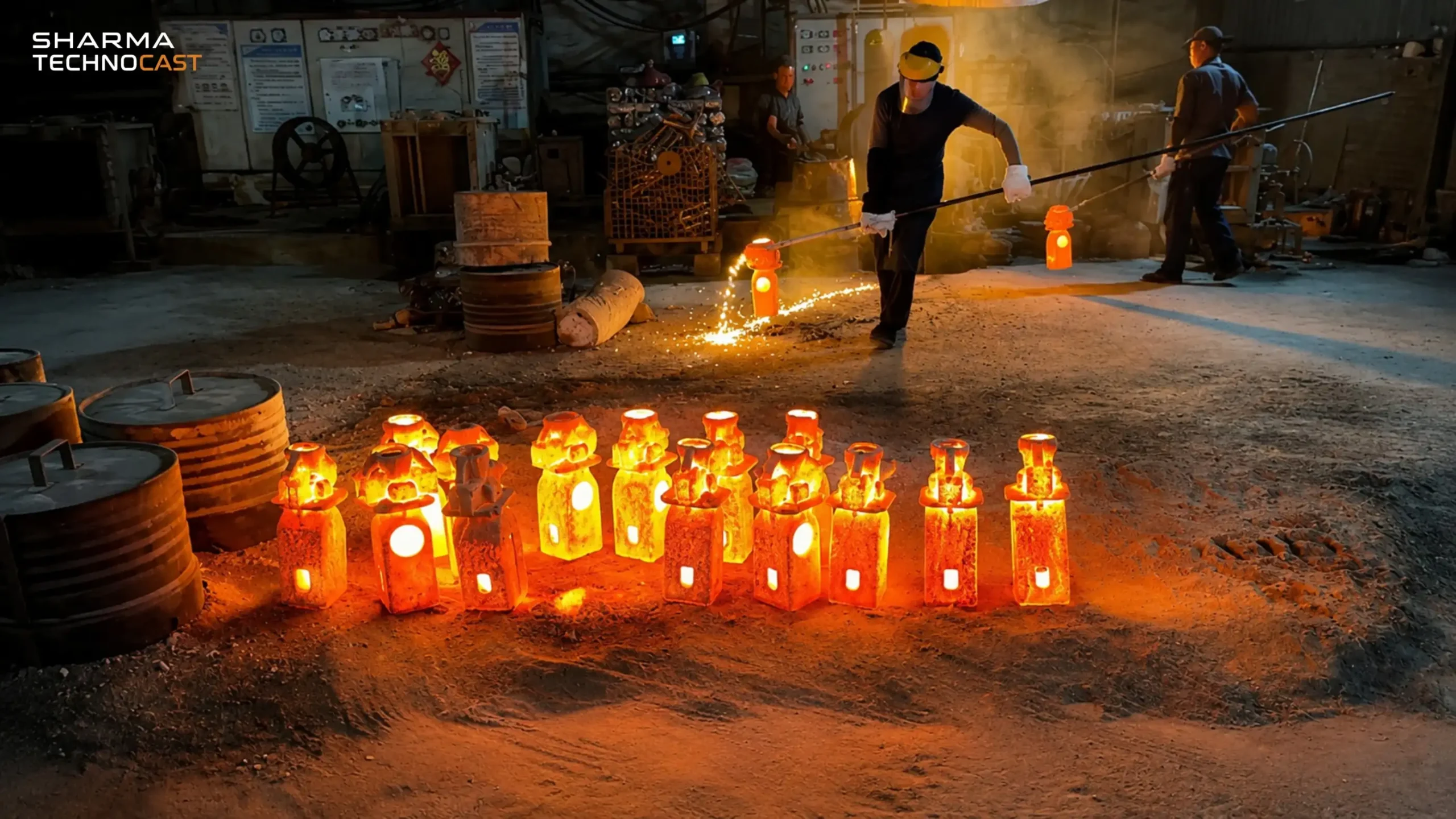
What is Investment Casting? Process, Advantages & Applications
Investment casting, also called the lost wax process, is one of the oldest precision metal forming methods still in heavy industrial use. It works by building a wax replica of the part, coating it in a ceramic shell, melting the wax out, and pouring molten metal into the hollow cavity that remains. Once the metal solidifies, the ceramic is broken away, leaving a metal component that closely matches the original wax pattern in shape, detail, and dimension.
What separates investment casting from ordinary casting is the level of precision it delivers. The wax pattern captures fine detail, and the ceramic shell reproduces it faithfully, so the finished part comes out close to final dimensions with a smooth surface finish. That means far less machining afterward, a real cost and time saving on complex components. The process handles metals that are difficult to shape any other way, including stainless steel, superalloys, and other high-melting-point materials.
For engineers, procurement managers, and OEM buyers choosing a manufacturing method for precise or complex components, understanding how investment casting works, and where it beats die casting and sand casting, is key to specifying the right process and controlling cost.
What Is Investment Casting (Lost Wax Casting)?
Investment casting is a precision casting process that produces near-net-shape metal parts using an expendable wax pattern and a ceramic mold. Near-net-shape means the part emerges very close to its final dimensions, so it needs minimal finishing.
Investment casting is one branch of the broader metal casting process, and it differs from the others mainly in how the mould gets made and then destroyed.
The name has nothing to do with money. The wax pattern is “invested”, surrounded and encased, in a refractory ceramic coating, and that ceramic covering is the investment. The alternative name, lost wax casting, describes the defining moment in the process: the wax is melted out and lost, leaving behind a hollow mold in its exact shape.
The technique dates back more than 5,000 years to ancient Egypt and China, where it was used for jewelry and ornamental metalwork. The core principle hasn’t changed. What has changed is the scale and precision. The same basic method now produces aerospace turbine blades, medical implants, and industrial valve bodies held to tolerances a fraction of a millimetre wide.
Two features distinguish it from other casting methods. The mold is destroyed to release each part, so every casting needs a fresh wax pattern and a fresh shell. And because the wax and ceramic reproduce fine detail so accurately, the process holds tighter tolerances and smoother surfaces than sand casting.
The Investment Casting Process: Step by Step
The process runs through a fixed sequence. Each stage feeds the next, and problems early on carry through to the final part, so foundries control every step closely.
Step 1 — Create the Wax Pattern
A wax model of the exact part is produced, usually by injecting molten wax into a metal die. The die is machined from aluminum or steel and represents the main upfront tooling cost. Once the die exists, hundreds or thousands of identical wax patterns can be shot from it. The wax pattern is a precise replica of the finished component, reproducing surface detail, part numbers, and logos.
Step 2 — Assemble the Wax Tree
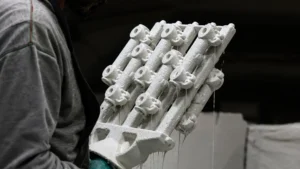
Individual wax patterns are attached to a central wax channel called a sprue, forming an assembly that resembles a tree with parts for branches. Casting many parts on one tree at once lowers cost and raises throughput. The sprue also forms the channels through which molten metal will later flow.
Step 3 — Build the Ceramic Shell
The wax tree is dipped repeatedly into a liquid ceramic slurry, then coated with fine sand or stucco between dips. Each layer dries before the next is applied. After several cycles, the shell is thick and strong enough to hold molten metal without cracking. This shell-building stage is slow, often needing a full day or more of drying between coats.
Step 4 — Dewaxing (the Lost Wax Step)
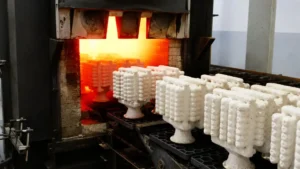
The ceramic-coated tree is heated in an autoclave or furnace. The wax melts and drains out, leaving a hollow ceramic mold in the exact shape of the patterns. This is where the process gets its name. The wax is often recovered and reused. The empty shell is then fired at high temperature, around 1,000°C, which hardens the ceramic and burns off any wax residue.
Step 5 — Pour the Molten Metal
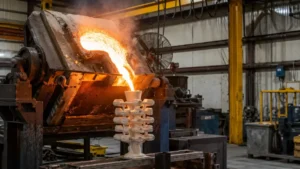
Metal is melted and poured into the hot ceramic mold, filling the cavity and the gating channels. Pouring into a preheated shell helps the metal flow into thin sections and fine detail before it begins to solidify. The tree is then left to cool and set.
Step 6 — Shell Removal and Finishing
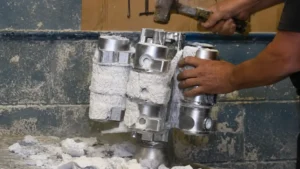
Once the metal has solidified, the ceramic shell is broken away by vibration, water jets, or knockout equipment. The individual parts are cut from the sprue. Each part then goes through finishing: grinding off gate marks, heat treatment where the alloy requires it, surface polishing, and any needed machining. Final inspection checks dimensions and internal soundness before shipping.
The video below shows the full sequence from wax pattern to finished casting:
https://www.youtube.com/watch?v=zubwbNDmEFA
Materials Used in Investment Casting
A major strength of investment casting is the range of metals it handles. Because the ceramic shell tolerates very high temperatures, the process works with alloys that have high melting points and are hard to machine.
- Stainless steel — the most widely used material in investment casting, chosen for corrosion resistance across chemical, food, marine, and medical applications
- Carbon steel and alloy steel — general engineering and structural components requiring strength and hardenability
- Duplex and heat-resistant steels — parts that face corrosion and high temperature together
- Aluminum alloys — weight-sensitive components in automotive and aerospace work
- Bronze and brass — valve parts, marine hardware, and corrosion-resistant fittings
- Nickel and cobalt-based superalloys — high-temperature parts such as turbine blades and engine components
The alloy choice comes down to what the part has to do. Corrosion resistance points toward stainless or duplex steel, high-temperature strength toward superalloys, and weight savings toward aluminum. This material flexibility is one reason a single process can serve industries as different as medical implants and oil-field valves.
Advantages of Investment Casting
The process earns its place through what it delivers on precision and complexity:
- High precision and fine surface finish — parts come out with tight tolerances, often down to ±0.1 mm depending on geometry, and smooth surfaces that reduce or remove secondary machining
- Complex geometries — thin walls, internal passages, undercuts, and intricate shapes that are difficult or impossible to machine can be cast directly, giving designers freedom other processes can’t match
- Wide material choice — the process handles ferrous and non-ferrous alloys, including metals that resist machining
- Near-net-shape parts — less material is wasted and less finishing is needed, which lowers the cost per part on complex components
- Consistency and repeatability — once the wax die is made, every pattern is identical, so castings stay consistent across a production run, which matters for OEM and export supply chains where parts must interchange
Disadvantages of Investment Casting
No process fits every job. It’s worth being clear about where investment casting falls short:
- Higher cost for simple parts — the process is labour-intensive, and building wax patterns and ceramic shells takes time and skilled work, so simpler shapes that a cheaper method could produce rarely justify it
- Longer lead times — the shell-building and drying stages alone can take days, so if parts are needed fast or the design keeps changing, the multi-step process slows you down
- Upfront tooling cost — the metal die for the wax patterns is expensive and can take weeks to make, so investment casting suits medium volumes better than one-off prototypes, though 3D-printed wax patterns are starting to shift this
- Size limits — the process works best on small to medium parts, since very large components are hard to gate and dip
For buyers, the honest takeaway is that investment casting pays off when you need precision and complex geometry in medium volumes. For simple, large, or extremely high-volume parts, another method is usually cheaper.
The process also brings its own failure modes. Shell cracking and wax pattern distortion produce casting defects that sand casting never sees, so shell build and dewaxing get controlled as tightly as the pour itself.
Investment Casting vs Die Casting vs Sand Casting
Buyers comparing casting methods usually weigh these three. They solve different problems.
Investment Casting vs Die Casting
Die casting forces molten metal under high pressure into a reusable steel mold. It is fast and cheap per part at high volumes and holds tight tolerances, but it is mostly limited to non-ferrous metals such as aluminum, zinc, and magnesium, because ferrous metals would wear out the steel die. Investment casting is slower and costs more per part, but it handles steel and superalloys, casts more complex shapes, and doesn’t need the enormous volumes that justify die-casting tooling. Choose die casting for high-volume aluminum or zinc parts. Choose investment casting for steel parts, intricate geometries, or medium volumes.
Investment Casting vs Sand Casting
Sand casting uses a sand mold and is the cheapest, most flexible option for large parts and low volumes. It produces rougher surfaces and looser tolerances, so parts usually need more machining afterward. Investment casting costs more but produces finer detail and smoother finishes with far less machining. Choose sand casting for large, simple, or heavy parts where surface finish isn’t critical. Choose investment casting when precision and finish matter.
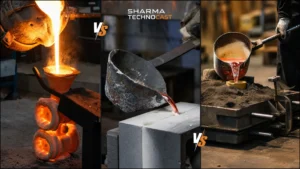
A simple way to decide: sand casting for size and cost, die casting for high-volume non-ferrous parts, and investment casting for precision and complex steel components.
Comparison Table
| Factor | Investment Casting | Die Casting | Sand Casting |
| Mold | Expendable ceramic shell (one use) | Reusable steel die | Expendable sand mold |
| Materials | Ferrous and non-ferrous, including steel and superalloys | Mostly non-ferrous (aluminum, zinc, magnesium) | Ferrous and non-ferrous |
| Tolerances | Tight (down to ±0.1 mm) | Tight | Loose |
| Surface finish | Smooth | Smooth | Rough |
| Part size | Small to medium | Small to medium | Small to very large |
| Tooling cost | Moderate to high | High | Low |
| Best volume | Low to medium | High | Low to medium |
| Best application | Precise, complex steel components | High-volume non-ferrous parts | Large, simple, heavy parts |
Applications of Investment Casting
Investment casting shows up wherever parts have to be precise and reliable, especially in safety-critical work:
- Aerospace — turbine blades, engine components, and structural brackets, where complex cooling channels and heat-resistant alloys are required
- Medical — surgical instruments and orthopaedic implants that need biocompatible alloys and tight tolerances
- Automotive — gears, rocker arms, and fuel system parts
- Oil, gas, and energy — valve bodies, pump components, and flanges that need corrosion resistance and strength
- Defence — firearm components and precision mechanisms
- General engineering — pump and valve parts, machine components, and custom industrial hardware
The common thread is parts that combine complex shapes, demanding materials, and a low tolerance for failure, the exact combination investment casting is built for.
Investment Casting in India
India has become one of the larger investment casting bases globally, with a strong concentration of foundries in Gujarat. Buyers choose Indian investment casting suppliers for a combination of quality and cost. Advanced foundries here cast a wide range of ferrous and non-ferrous alloys, hold international quality standards, and serve both domestic OEMs and export markets across automotive, valve and pump, oil and gas, and general engineering sectors.
Investment casting at Sharma Technocast runs alongside sand and gravity casting at our metal casting facility in Ahmedabad, with forging and machining on the same site.
FAQ’s
Q1. What is investment casting in simple terms?
Investment casting is a way to make precise metal parts by creating a wax copy of the part, coating it in ceramic to form a mold, melting the wax out, and pouring molten metal into the hollow mold. Once the metal cools, the ceramic is broken away to reveal the finished part.
Q2. Why is it called lost wax casting?
Because the wax pattern is melted and drained out of the ceramic shell during the process, it is lost. The hollow space left behind becomes the mold cavity for the molten metal.
Q3. What are the steps in the investment casting process?
The main steps are creating the wax pattern, assembling the wax tree, building the ceramic shell, dewaxing (melting out the wax), pouring the molten metal, and finally removing the shell and finishing the part.
Q4. What metals can be investment cast?
The process handles a wide range of alloys including stainless steel, carbon and alloy steel, aluminum, bronze, brass, and nickel or cobalt-based superalloys. This flexibility is one of its main advantages over die casting.
Q5. What is the difference between investment casting and die casting?
Die casting injects metal under pressure into a reusable steel mold and is best for high-volume, non-ferrous parts. Investment casting uses an expendable ceramic mold, handles steel and superalloys, and produces more complex shapes, but costs more per part and takes longer.
Q6. What is the difference between investment casting and sand casting?
Sand casting is cheaper and suited to large, simple parts, but gives rough surfaces and loose tolerances. Investment casting costs more but produces fine detail, smooth finishes, and tight tolerances with far less machining.
Q7. What are the main disadvantages of investment casting?
The main drawbacks are higher cost for simple parts, longer lead times because of the multi-step shell-building process, upfront tooling cost for the wax die, and size limits that make it best suited to small and medium components.
Q8. What are the advantages of investment casting?
It produces high-precision parts with smooth surface finishes and complex geometries, works with a wide range of metals, reduces the need for machining through near-net-shape casting, and delivers consistent, repeatable results across a production run.
Q9. Which industries use investment casting the most?
Aerospace, medical, automotive, defence, and the oil and gas sector rely on it heavily, mainly for parts that need precision, complex geometry, and high-performance materials.
Q10. How precise is investment casting?
Investment casting holds tight tolerances, often down to around ±0.1 mm depending on part geometry and size, with smooth as-cast surfaces that reduce or eliminate secondary machining.