

Sharma Technocast manufactures industrial pumps for chemical, petrochemical, pharmaceutical, sugar, paper, and effluent treatment plants. Every pump is built around a specific duty, whether that's moving corrosive acid, thick sludge, hot thermic fluid, or clean high-pressure water. Hydraulic design conforms to ISO 2858 with DIN 2543 flanges, and pumps are offered in cast iron, cast steel, SS 304/316, Alloy-20, CD4MCU, and Hastelloy B & C depending on the fluid.
Choosing the wrong pump is expensive. A pump sized for clean water fails fast on abrasive slurry, and a metal pump corrodes in weeks if the fluid is a strong acid. So we build pumps by application rather than selling one design for every job.
The range covers nine pump categories and more than 20 series — from dosing pumps metering a few litres an hour to axial flow pumps moving thousands of cubic metres. Because casings, shafts, and impellers come from our own casting line, our forging facility, and our CNC machining, we control the pump from raw metal to finished assembly.
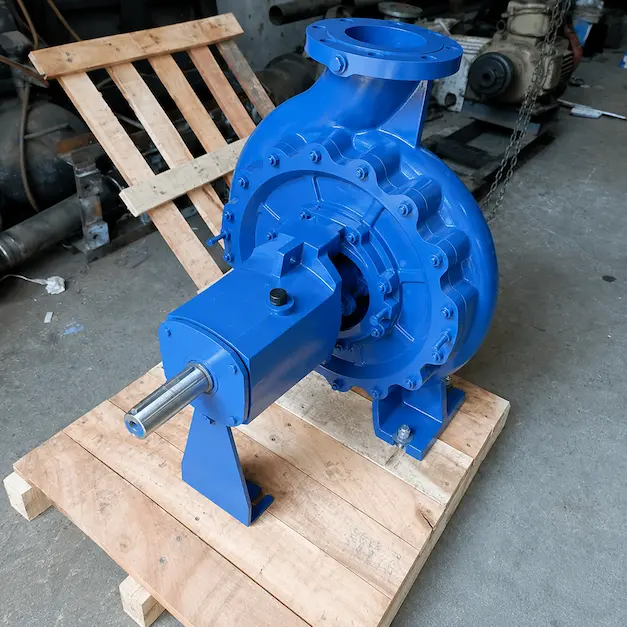
Industrial pumps move liquids through a process plant — feeding boilers, circulating cooling water, transferring chemicals, dosing reagents, dewatering pits, and pumping effluent to treatment. Unlike domestic pumps, they run continuous duty, handle aggressive fluids, and are built to be repaired rather than thrown away.
Centrifugal pumps use a spinning impeller to add velocity to the liquid, which converts to pressure and flow — suited to most water and thin-chemical duties. Positive displacement pumps trap a fixed volume and push it through, so they handle viscous, high-pressure, or precise-metering jobs a centrifugal pump can't.
The fluid decides the material: water and mild chemicals run in cast iron or bronze; acids and solvents need SS 316, Alloy-20, or a fluoropolymer lining like PVDF or PTFE; highly corrosive effluent often runs best in a solid polypropylene pump with no metal wetted parts at all.
Each category is built for a different job. Pick the one that matches your duty.
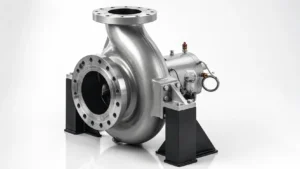
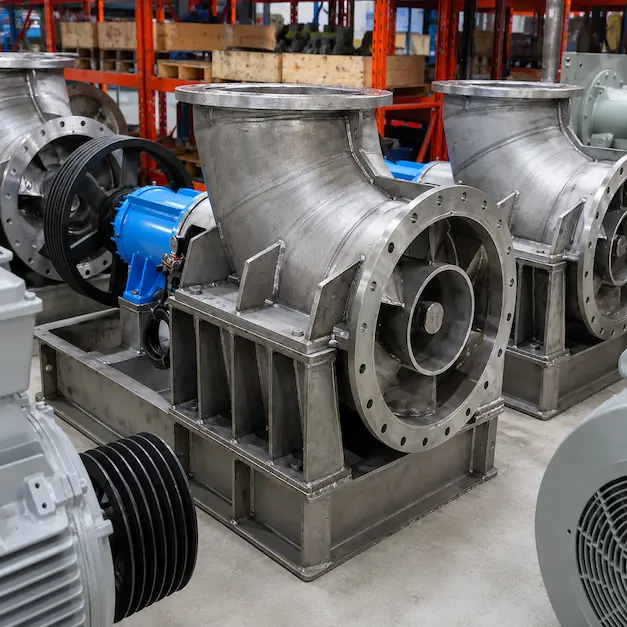
End-suction, split-casing, axial flow and hot oil centrifugal pumps for water, process and thermic fluid duty.
View Range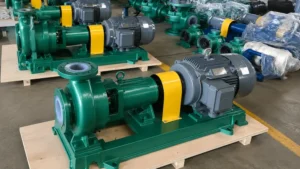
Corrosion-resistant pumps in polypropylene, PVDF, and PTFE lining for acids, alkalis, and effluent.
View Range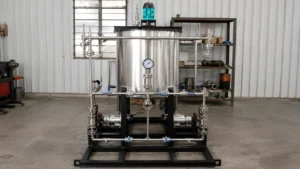
plunger and diaphragm metering pumps for precise chemical dosing.
View Range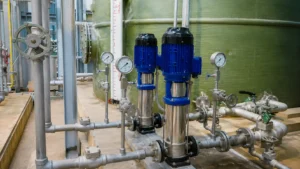
Multistage pumps for boiler feed, boosting, and high-rise water supply.
View Range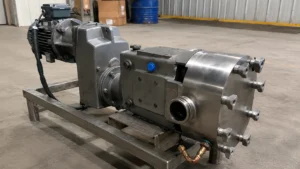
Rotary gear and progressive cavity pumps for viscous liquids like oil, molasses, and sludge.
View Range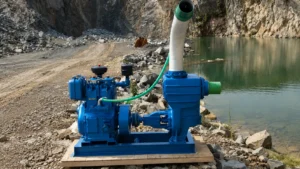
non-clog pumps that prime themselves for mud, sewage, and dewatering where the pump sits above the liquid.
View Range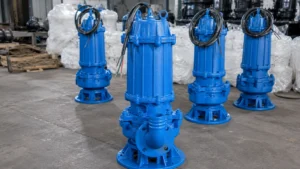
Sewage and effluent pumps that run fully submerged in the sump.
View Range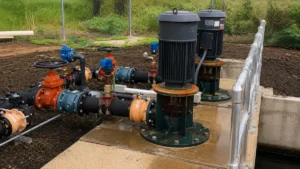
Long-shaft sump pumps for tanks and pits where floor space is tight.
View Range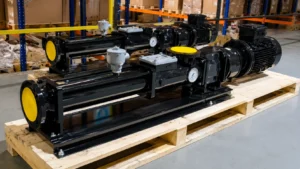
Vacuum-assisted separator pumps for paper mill and process water recovery.
View RangeCasings come off our own casting line, shafts come from our forging facility, and impellers and bearing housings are finished on our CNC machines — melt to final bore.
Twenty-plus series exist because twenty-plus distinct duties exist. You get a pump matched to your fluid, not the nearest available size.
CI, CS, SS 304/304L, SS 316/316L, bronze, Alloy-20, CD4MCU, Hastelloy B & C, plus PP, PVDF, and PTFE for corrosive service.
Hydraulic design to ISO 2858 and flanges to DIN 2543 on the process pump range, so pumps are interchangeable and spares stay predictable.
Most of the centrifugal range is back pull-out, so the rotating assembly comes out for service without disturbing the pipework or casing. Less downtime.
Across these categories, Sharma Technocast pumps handle hot and cold water circulation, cooling water, condensate, and fire-fighting systems. They transfer acids, alkalis, solvents, slurries, and hydrocarbons. They dose polyelectrolyte and boiler chemicals, feed filter presses, dewater mines and construction pits, and pump effluent through ETP and STP plants. Viscous duties like oil, molasses, coal tar, and glycerine run on the positive displacement range.
If your duty isn't a standard fit, we build to drawing. Send the fluid, flow, head, and temperature, and we'll match a series or engineer a custom option.
Chemical, petrochemical, pharmaceutical, sugar, paper, steel, textile, food, power, and municipal water treatment, among others. The right pump depends on the fluid and duty rather than the industry name.
Yes. Material selection is driven by the fluid. Acids and solvents run in SS 316, Alloy-20, or PTFE/PVDF-lined bodies; highly corrosive effluent runs in solid polypropylene. Share the fluid and concentration and we'll specify the wetted parts.
We manufacture them. Casings are cast on our own casting line, shafts come from our forging facility, components are machined on our CNC lines, and every pump is assembled and tested before dispatch.
The range spans low-flow dosing pumps up to high-volume axial flow pumps, with heads from a few metres to a few hundred metres on the multistage range. Each category and product page lists its operating envelope.
Yes. Impellers, casings, shafts, sleeves, mechanical seals, and bearings are available for the full range, made through the same casting, forging and machining route as the original parts.
Yes. Send the duty conditions (fluid, flow, head, temperature, pressure) and we'll match an existing series or engineer a custom build.
Send us your duty conditions and our engineers will match a series or quote a custom build.