

What Is Sand Casting?
Sand casting is a metal casting process that uses a mould formed from compacted sand to shape molten metal. It is one of the oldest and most versatile casting methods, suited to a wide range of metals and to components from small parts to very large castings.
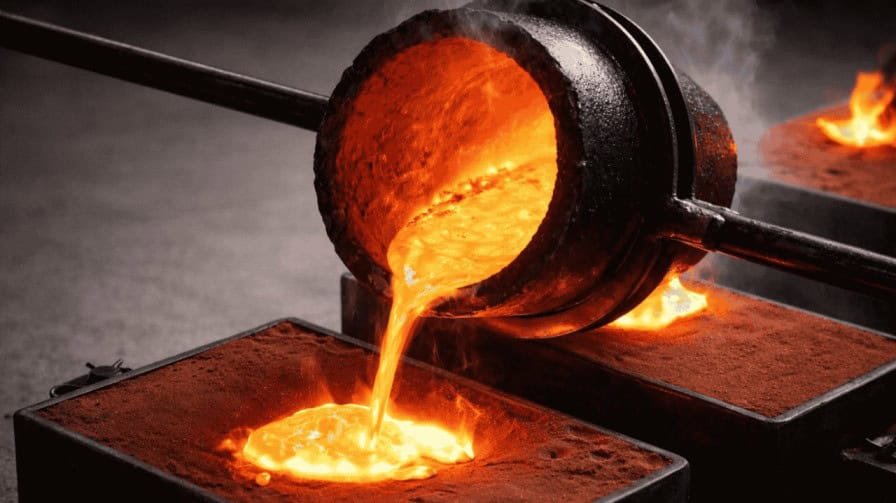
The process uses a pattern — a replica of the part — to form a cavity in the sand. Molten metal is poured into this cavity, allowed to solidify, and the sand mould is then broken away to release the casting. Because the mould is expendable, a new mould is made for each casting.
How the Sand Casting Process Works
1. Pattern and mould preparation. A pattern of the part is placed in a moulding box (flask). The lower half of the mould, the drag, is formed by packing sand around the pattern on a flat surface. The upper half, the cope, is formed by placing the top flask and packing sand around the second half of the pattern.
2. Core setting. Where internal cavities are required, a sand core is placed into the mould.
3. Pouring. The mould halves are closed and molten metal is poured through the gating system into the cavity.
4. Cooling and solidification. The metal is left to cool and solidify within the mould.
5. Shakeout and finishing. The sand mould is broken away, and the casting is cleaned, with gates and risers removed. Machining follows where final dimensions or features such as threads are required.
Because the mould is made fresh for every part, mould quality drives most of what goes wrong. Defects such as sand inclusions and metal penetration come from ramming and venting rather than from the metal itself.
Advantages of Sand Casting
- Material flexibility — works with ferrous and non-ferrous metals
- Size range — suitable for both small parts and very large castings
- Low tooling cost — patterns and sand moulds are inexpensive relative to die casting
- Design freedom — accommodates complex shapes and internal cavities via cores
- Economical for low volumes — no expensive permanent tooling required
Limitations of Sand Casting
- Surface finish — rougher than die or investment casting
- Tolerances — looser dimensional accuracy, so post-casting machining is often needed
- Slower for high volumes — less efficient than die casting for large production runs, generally above around 1,000 pieces
Where a part needs finer detail or a tighter tolerance than a sand mould can hold, investment casting is usually the better route, though both tooling and unit cost rise with it.
Applications of Sand Casting
Sand casting is used for engine blocks, pump and valve bodies, machine bases, pipe fittings, large housings, and heavy engineering components across the automotive, construction, and general engineering sectors.
Sand casting also owns the top of the size range. Heavy engineering castings running into several tonnes, such as crusher bodies and machine bases, are almost always sand cast because no other process handles that mass economically.
Sand Casting at Sharma Technocast
Sharma Technocast provides sand casting within its integrated metal casting operation in Ahmedabad, India, serving industrial and OEM clients across India and worldwide. See also our guide on aluminium casting and the metal casting overview.