

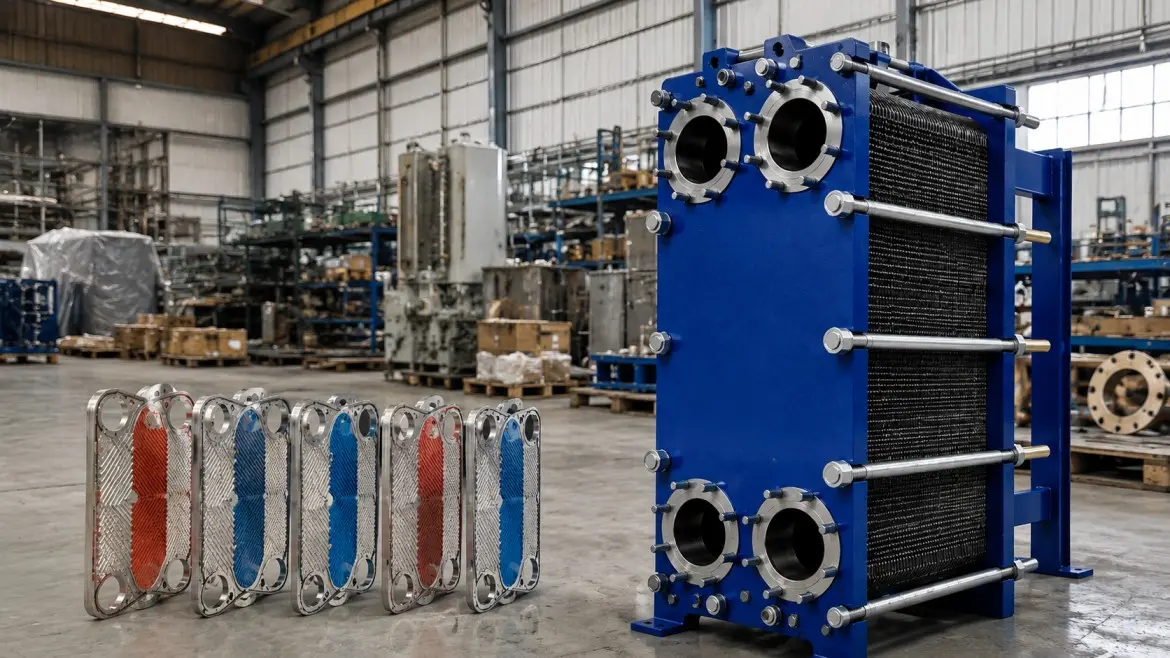
A plate heat exchanger (PHE) transfers heat between two fluids using a stack of thin, corrugated metal plates that keep the fluids separate while letting heat pass through the plate wall. Because almost the entire plate surface does thermal work, a PHE reaches efficiencies of up to around 90% in a body three to five times smaller than a shell and tube unit of the same duty. The main types are gasketed, brazed, welded, and semi-welded.
Heat exchangers move heat from a hot fluid to a cold one without letting them mix. The plate design does this with pressed metal plates instead of the tube bundle you’d find in a shell and tube unit. It’s compact, easy to service, and one of the most common heat transfer devices in Indian process plants, HVAC systems, dairies, and pharmaceutical units.
This guide covers what a plate heat exchanger is, how it works, what the plates and gaskets are made of, the different types, and where these units are used.
What Is a Plate Heat Exchanger?
A plate heat exchanger is a device that transfers heat between two fluids through a series of metal plates clamped together in a frame. Each plate carries a corrugated pattern, and the gaps between plates form thin channels. Hot fluid runs through one set of channels and cold fluid through the next, so every plate has hot fluid on one face and cold fluid on the other. Heat conducts straight through the plate from the hot side to the cold side.
The fluids never touch. Gaskets or welds seal the edges of each plate and route each fluid into its own set of channels. The result is a large heat transfer area folded into a small footprint, which is why a plate unit handles the same thermal load as a much larger shell and tube exchanger.
The first plate heat exchangers appeared in the 1920s for pasteurising milk, where gentle, hygienic heating mattered. The same qualities that suited dairy work then, high efficiency and easy cleaning, are why the design spread across chemical, HVAC, and power applications.
How Does a Plate Heat Exchanger Work?
A plate heat exchanger works on a simple rule of thermodynamics: heat always flows from the hotter fluid to the colder one when the two are separated by a conductive surface. The plates are that surface. The clever part is how the design squeezes maximum heat transfer out of a small space.
The Role of Corrugated Plates
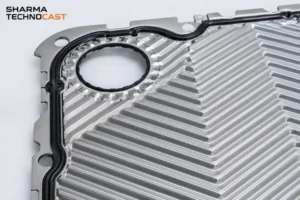
Look closely at a heat exchanger plate and you’ll see a herringbone or chevron pattern pressed into the metal. That corrugation isn’t decorative. It does three jobs. It increases the surface area available for heat transfer. It forces the fluid to follow a twisting path, which creates turbulence. And it gives the thin plate mechanical strength so it can hold pressure without buckling.
Turbulence is the key to a PHE’s performance. In a smooth channel, fluid near the plate wall moves slowly and forms an insulating layer that slows heat transfer. The corrugation breaks up that layer and keeps the fluid mixing, so more of it makes contact with the hot plate. This is why a plate exchanger transfers heat far more efficiently per square metre than a plain tube.
Counter-Flow Heat Transfer
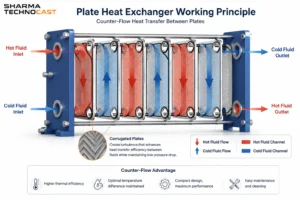
In most plate heat exchangers the two fluids run in opposite directions, which engineers call counter-flow. The hot fluid enters at one end and the cold fluid enters at the other, so they pass each other travelling in reverse.
Counter-flow matters because it keeps a temperature difference along the whole length of the plate. The cold fluid leaving the exchanger meets the hottest incoming fluid, and the hot fluid leaving meets the coldest incoming fluid. That steady gap lets the cold fluid come out very close to the hot fluid’s inlet temperature, something a same-direction flow can’t achieve. It’s the reason plate exchangers hit close temperature approaches that other designs struggle with.
How the Gaskets Direct Flow
Each plate has ports at its corners for fluid to enter and leave. Rubber gaskets sit in a groove around the edge of every plate and around these ports. When the plates are clamped together, the gaskets seal the stack and, more importantly, decide which channels each fluid can enter.
The gasket pattern alternates from plate to plate. One plate’s gaskets open the corner ports to let hot fluid into that channel while blocking cold fluid. The next plate is arranged the opposite way. Stack them and you get hot and cold channels alternating all the way through, with no mixing and no external leaks.
What Are Plate Heat Exchangers Made Of?
The material of a plate heat exchanger depends on the fluids it handles and the temperature and pressure it runs at. A unit for clean water uses cheaper metal than one handling seawater or acid. The choice splits across three parts: the plates, the gaskets, and the frame.
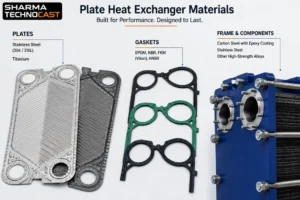
Plate Materials
Most plates are stainless steel, usually grade 304 for mild duties and 316 or 316L where the fluid is more corrosive. Stainless handles high temperatures, resists corrosion, and takes the corrugation press well.
For harsher service the plate metal changes. Titanium is the standard choice for seawater, brine, and chloride-heavy fluids that would pit stainless steel. Nickel alloys and, in some cases, graphite are used for strong acids. Plates are typically pressed from sheet between 0.4 mm and 1.0 mm thick, thin enough to conduct heat well but strong enough once corrugated to hold working pressure.
Gasket Materials
Gaskets are chosen for the fluid and the operating temperature. Nitrile rubber (NBR) suits water and oils at moderate temperatures. EPDM handles hot water and steam. Viton (FKM) is used for oils, fuels, and higher temperatures where the cheaper rubbers would break down. Getting the gasket material wrong is a common cause of early failure, because a gasket that isn’t compatible with the fluid will swell, harden, or leak.
Frame and Structural Components
The plate pack is held between two heavy end plates, the fixed frame plate and the movable pressure plate, drawn together by tightening bolts. Carrier bars at the top and bottom guide the plates and support the stack. The frame plates and the connection ports are commonly cast or fabricated from carbon steel and then lined or coated where they contact the process fluid. These heavy structural parts are where in-house casting and machining make a real difference to quality, since the port faces and sealing surfaces need accurate finishing to seal reliably.
Types of Plate Heat Exchangers
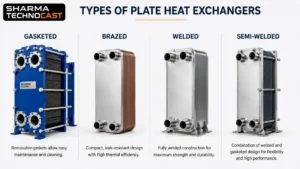
Plate heat exchangers are grouped by how the plates are sealed together. The sealing method decides the pressure and temperature the unit can take, how easily it’s cleaned, and whether you can add plates later.
Gasketed Plate Heat Exchanger
The gasketed type uses rubber gaskets between plates and is the most common design in industry. Its big advantage is flexibility. The plate pack can be opened for cleaning and inspection, and you can add or remove plates to change capacity as your process changes. This makes it the default choice where fouling fluids need regular cleaning or where future expansion is likely.
Brazed Plate Heat Exchanger
A brazed plate heat exchanger has no gaskets. The plates are bonded together with copper or nickel braze, forming a sealed block. This makes it compact, able to hold higher pressures, and maintenance-free, but it can’t be opened for cleaning or expanded later. Brazed units are common in refrigeration, HVAC, and combi boilers where the duty is fixed and the unit is small.
Welded and Semi-Welded Plate Heat Exchanger
Fully welded plate exchangers replace gaskets with welded seals, so they handle aggressive fluids and high temperatures that would destroy rubber. Semi-welded units are a middle path: pairs of plates are welded together for the aggressive fluid, while the other side stays gasketed for easy service. Semi-welded designs are popular in ammonia refrigeration, where one fluid is harsh and the other is not.
(A detailed comparison of these types, with selection guidance, is covered in our dedicated guide on plate heat exchanger types.)
Plate Heat Exchanger vs Shell and Tube
The shell and tube heat exchanger uses a bundle of tubes inside a cylindrical shell, while a plate exchanger uses stacked plates. The practical difference is size and efficiency. A plate unit puts nearly all its metal to work transferring heat, so it does the same job in a much smaller body and reaches closer temperature approaches. A shell and tube unit handles higher pressures and temperatures and copes better with dirty or high-viscosity fluids.
For most water, chemical, and HVAC duties at moderate pressure, a plate exchanger is the more compact and efficient choice. For very high pressure, high temperature, or heavily fouling service, shell and tube still wins.
Advantages of Plate Heat Exchangers
The plate design earns its place for a few clear reasons:
- High efficiency. Corrugated plates and turbulent flow give heat transfer coefficients several times higher than a plain tube, so a smaller unit does the same duty.
- Compact footprint. A plate exchanger can be three to five times smaller than a shell and tube unit of equivalent capacity, which matters when floor space is tight.
- Easy maintenance. Gasketed units open up fully, so plates can be cleaned, inspected, or replaced without cutting anything.
- Flexible capacity. Add plates to a gasketed unit and it handles more load. Few other designs let you scale after installation.
- Close temperature approach. Counter-flow operation lets the fluids reach temperatures within a degree or two of each other, which improves heat recovery.
What Are Plate Heat Exchangers Used For?
Plate heat exchangers show up wherever two fluids need to exchange heat efficiently in a limited space. The design started in dairies and spread out from there.
In food and dairy plants they pasteurise milk, cool products, and heat process water, where hygiene and gentle handling matter. In HVAC and district heating they transfer heat between chilled and hot water circuits and separate primary and secondary loops. Chemical and pharmaceutical plants use them for heating, cooling, and heat recovery on process streams. Power plants and marine systems use them for cooling lube oil, jacket water, and closed cooling circuits, with titanium plates handling seawater duty.
Across Indian industry the common threads are the same: high thermal efficiency, a small footprint, and easy cleaning. That combination suits sugar mills, breweries, textile processing, and effluent treatment as much as it suits the dairies where the design began.

Choosing a Plate Heat Exchanger Manufacturer in India
The right plate heat exchanger depends on your fluid, flow rate, temperatures, and pressure, not on a catalogue size. A good manufacturer works from your duty conditions, selects the plate and gasket materials to match the fluid, and sizes the plate count for your load.
Sharma Technocast manufactures industrial heat exchangers in Ahmedabad, with the casting, forging, and CNC machining lines to produce plates, ports, and frame components in-house. That control over the metal, from raw material to finished sealing face, is what keeps a plate exchanger leak-free over its service life. If you have a heat transfer duty to solve, share your fluid, flow, temperature, and pressure and our engineers will match a unit to it.
FREQUENTLY ASKED QUESTIONS
Q1. What is a plate heat exchanger?
A plate heat exchanger is a device that transfers heat between two fluids using a stack of thin, corrugated metal plates. Each fluid flows through alternate channels between the plates, so heat passes through the plate wall while the fluids stay separate.
Q2. How does a plate heat exchanger work?
Hot and cold fluids flow through alternating channels formed between corrugated plates. Heat conducts through each plate from the hot side to the cold side. The corrugations create turbulence that boosts heat transfer, and counter-flow operation keeps a temperature difference along the whole plate for maximum heat recovery.
Q3. What are plate heat exchangers made of?
The plates are usually stainless steel (304 or 316), with titanium used for seawater and corrosive fluids. Gaskets are made from rubber compounds such as NBR, EPDM, or Viton, chosen to suit the fluid and temperature. The frame and ports are typically carbon steel, cast or fabricated.
Q4. What are plate heat exchangers used for?
They are used in food and dairy processing, HVAC and district heating, chemical and pharmaceutical plants, power generation, and marine cooling. Any application needing efficient heat transfer in a compact, easy-to-clean unit is a good fit.
Q5. What are the main types of plate heat exchangers?
The four main types are gasketed (most common, easy to clean and expand), brazed (compact and pressure-rated, no gaskets), welded (for aggressive fluids and high temperatures), and semi-welded (one side welded, one gasketed, common in ammonia refrigeration).
Q6. What is the difference between a plate and a shell and tube heat exchanger?
A plate exchanger is more compact and efficient for moderate-pressure water, chemical, and HVAC duties. A shell and tube exchanger handles higher pressures and temperatures and copes better with dirty or high-viscosity fluids.
Q7. How efficient is a plate heat exchanger?
A plate heat exchanger can reach thermal efficiencies of up to around 90% and needs a body three to five times smaller than a shell and tube unit of the same duty, thanks to the large plate surface area and turbulent flow.