

CNC Machining vs 3D Printing: Which Process Is Right for Your Part?
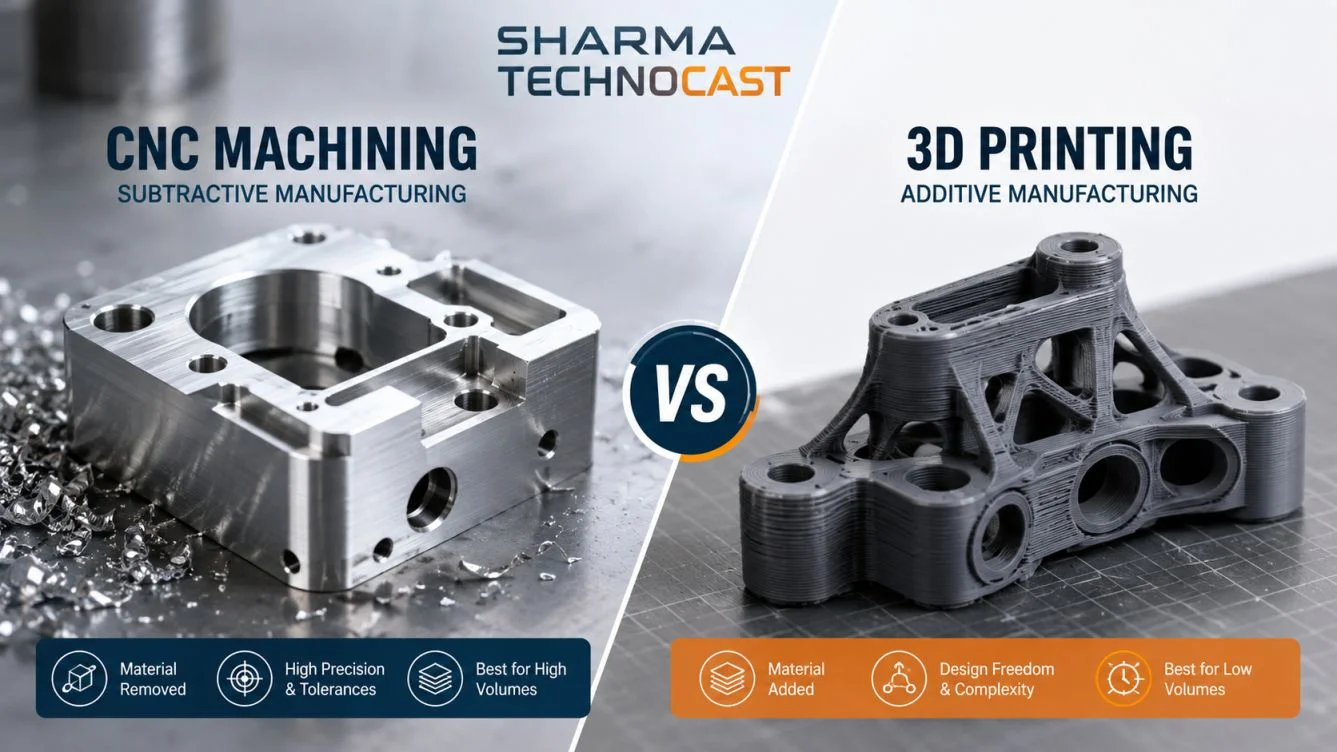
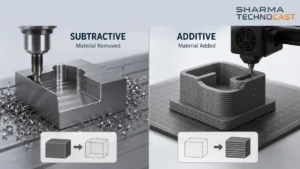
CNC machining and 3D printing are opposite approaches to making a part. CNC machining is subtractive: it cuts a finished shape out of a solid block. 3D printing is additive: it builds a part up layer by layer. CNC wins on strength, tight tolerances, surface finish, and cost at volume. 3D printing wins on complex geometry, single-part speed, and low-volume cost. Most tight-tolerance metal parts are machined; complex prototypes are printed.
Both processes start from a digital file and both can turn that file into a physical part. What they do with the material is where they split. That single difference, removing material versus adding it, decides which one gives you a stronger part, a tighter tolerance, a smoother finish, or a lower price, and it changes with the part in front of you.
This guide compares the two across the factors that actually drive the decision: strength, precision, surface finish, geometry, materials, speed, and cost. It ends with a simple framework for choosing.
CNC Machining vs 3D Printing at a Glance
| Factor | CNC Machining | 3D Printing |
| Method | Subtractive (cuts from a solid block) | Additive (builds layer by layer) |
| Typical tolerance | ±0.025 mm standard, to ±0.005 mm | ±0.1–0.5 mm (layer dependent) |
| Surface finish (Ra) | As low as 0.8 μm, as-machined | Around 15 μm, visible layer lines |
| Strength | Full strength of the stock material | Often 10–20% lower, layer-dependent |
| Geometry | Limited by tool access | Handles internal channels, lattices, organic shapes |
| Materials | Wide range of metals and plastics | Mostly plastics, some metals |
| Best volume | Medium to high | One-off to low volume |
| Cost crossover | Cheaper above ~10–25 parts | Cheaper below ~10–25 parts |
The rest of this guide explains what sits behind each of these rows.
What Is CNC Machining?
CNC machining is a subtractive process. It starts with a solid block, bar, or billet of material and removes metal with computer-controlled cutting tools until the part matches the drawing. The operations include milling, turning, drilling, and grinding, run across three to five axes. The tool paths come from a CAD file, and the machine follows them with high repeatability, so the thousandth part is virtually identical to the first.
Because the part is cut from one continuous piece of stock, its internal grain structure stays intact. That’s why a machined part keeps the full mechanical properties of the material it started from. For a fuller breakdown of the cutting methods involved, see our guide on the types of CNC machining operations.
What Is 3D Printing?
3D printing, also called additive manufacturing, builds a part from the ground up. The machine deposits or fuses material one thin layer at a time until the full shape exists. It covers a family of processes, including FDM (fused deposition), SLA (resin), SLS (powder-bed nylon), and metal methods like DMLS and SLM that fuse metal powder with a laser.
Building in layers gives 3D printing its main strength: it can create shapes a cutting tool can’t reach, like internal cooling channels, lattice structures, and organic curves. The same layering is also its main weakness, because the bonds between layers introduce direction-dependent behaviour that a solid block doesn’t have.
Key Differences Between CNC Machining and 3D Printing
The two processes diverge on seven factors that matter to a working part. Here’s how each one compares.
Material Strength and Properties
CNC machined parts carry the full strength of the stock. A machined aluminium part has the same tensile strength as the billet it was cut from, and its properties are the same in every direction (isotropic).
3D printed parts don’t behave that way. Because they’re built in layers, the bond between layers is usually weaker than the material within a layer, so the part is stronger in some directions than others (anisotropic). A DMLS aluminium part can come out around 10 to 20 percent weaker than the same part machined from solid, largely due to porosity between fused powder. For a load-bearing component, that difference decides the process.
 Precision and Tolerance
This is CNC machining’s clearest advantage. A three-axis mill routinely holds ±0.025 mm on general features and tightens to ±0.005 mm on critical dimensions like bearing bores and mating surfaces. Turning and grinding go finer still.
3D printing works to looser tolerances. Layer thickness typically runs 0.1 to 0.5 mm, and dimensional accuracy drifts across a large part. On a 200 mm printed part, a pattern of holes can shift 0.3 to 0.5 mm from where the drawing puts them. On a machined part, that same pattern holds within about ±0.02 mm. Three practical cases where this bites: threaded holes at M4 and below, which printed processes can’t hold reliably and which strip on first assembly; press fits and bearing bores, where an interference fit needs tolerances no printer reaches without post-machining; and any sealing or locating face that has to mate with another part.
Surface Finish
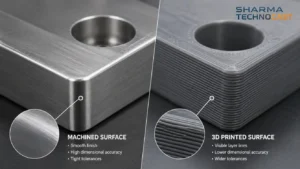
A machined surface comes off the machine smooth, with roughness as low as around 0.8 μm Ra, and it can often go straight into service. The finish is uniform because the cutter path controls it.
A printed surface carries the layer lines from how it was built. Roughness sits around 15 μm, and sloped or curved faces show a visible stair-step where the layers meet. Printed parts usually need post-processing, sanding, bead blasting, or machining to reach a functional or cosmetic finish, which adds time and cost.
Geometric Complexity
Here the advantage flips to 3D printing. Additive builds have no tool to fit into the part, so they can make features that are impossible to machine: fully internal channels, hollow lattices for weight reduction, and organic topology-optimized shapes. A famous example is a fuel nozzle that consolidated 20 separate machined parts into one printed component with internal cooling passages.
CNC machining is bound by tool access. If a cutter can’t physically reach a feature, it can’t make it, and deep or enclosed geometry may need several setups or simply isn’t machinable. For parts defined by complex internal geometry, printing does what cutting can’t.
Materials
CNC machining handles a broad material range: aluminium, steel, stainless, titanium, brass, copper, and engineering plastics like Delrin and PEEK, all in their full production-grade form. If your final part is a specific metal alloy, machining almost always supports it.
3D printing’s material list is narrower and often process-specific. Most printing is plastic; metal printing exists but is limited to certain powders and costs considerably more. If your material isn’t available as a printable powder or filament, machining is the only route.
Speed and Production Volume
The two win at opposite ends. For a single part, 3D printing is usually faster for the first part because there’s no fixturing or programming to set up, just upload and print. That makes it ideal for rapid iteration.
CNC machining carries a setup cost per job, but once it’s running, each part is quick. So CNC pulls ahead as volume rises. For medium and high volumes, the machined per-part cost drops well below printing because the setup is spread across many parts and the cycle time is short.
 Cost
Cost
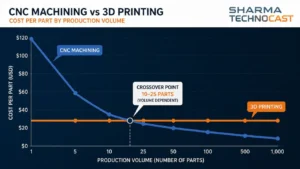
Cost follows volume, and the two lines cross. 3D printing has no tooling or setup fee, so a one-off print can start at a few dollars to tens of dollars, cheaper than a machined one-off that carries programming and fixturing costs. But the printed per-part price stays roughly flat as quantity grows.
CNC machining starts higher for the first part, and then the per-part cost falls with volume. The crossover typically lands somewhere around 10 to 25 parts: below that, printing is usually cheaper; above it, machining pulls ahead and keeps widening the gap. Part complexity moves the crossover since very complex internal geometry keeps printing competitive for longer.
When to Choose CNC Machining
Choose CNC machining when the part has to perform. It’s the right process when you need tight tolerances, a smooth as-machined finish, full material strength, or production-grade metal. That covers most functional metal components: shafts, housings, brackets, valve bodies, fittings, and anything with mating surfaces, threads, or sealing faces.
It’s also the more economical choice once you’re past a handful of parts. For medium and high volumes of metal components, machining wins on both cost and consistency. As a rule, if any critical feature needs a tolerance tighter than about ±0.05 mm, machining is your primary process.
When to Choose 3D Printing
Choose 3D printing when geometry or speed matters more than strength and precision. It’s the right process for a complex prototype you need in a day or two, for shapes with internal channels or lattices that no cutter can reach, and for one-off or very low-volume parts where machining setup cost isn’t justified.
It suits early design iteration, where you’re checking form and fit and the rough finish doesn’t matter, and weight-critical parts where a lattice or topology-optimized structure saves mass a solid billet can’t. For non-structural, low-tolerance parts, printing is often perfectly adequate and faster to get in hand.
 Using Both Together
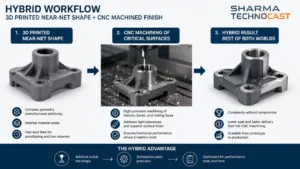
The two processes aren’t always a choice. A common approach is to use them in sequence: 3D print a complex near-net shape to capture geometry a cutter can’t make, then CNC machine the critical surfaces, bores, and threads to bring them to tolerance. This hybrid route combines additive’s design freedom with subtractive’s accuracy, and it’s standard in aerospace and medical work where a part has both complex internal geometry and precise mating features. It can also cut total cost on intricate parts by reducing the material a full machining job would have removed.
How to Decide: A Quick Framework
Work through these questions in order, and the right process usually becomes clear.
- Does the part have complex internal geometry a tool can’t reach? If yes, lean toward 3D printing (or a hybrid). If no, continue.
- Does any critical feature need a tolerance tighter than about ±0.05 mm, or a sealing/mating surface? If yes, CNC machining is your primary process. If no, continue.
- Is it a load-bearing part that needs full material strength? If yes, favor CNC machining. If no, continue.
- What’s the volume? One-off to a handful → 3D printing is usually faster and cheaper. Above roughly 10 to 25 parts → CNC machining becomes more economical.
- What’s the material? A specific production metal or high-performance plastic usually means CNC machining. A standard printable plastic where properties aren’t critical can go either way.
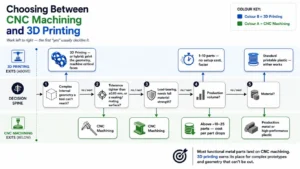
Most real parts land on machining for the functional, tight-tolerance metal work, with printing reserved for complex prototypes and geometry that can’t be cut.
CNC Machining Services at Sharma Technocast
Sharma Technocast runs CNC milling, turning, and multi-axis machining at its Ahmedabad facility, producing functional metal components for OEM and industrial applications across India and export markets. With casting, forging, and machining under one roof, parts can start from our own castings or forgings and finish to accurate final dimensions in-house. If you have a component to make and you’re weighing how to produce it, send the drawing with your material, tolerance, and quantity, and our team will advise on the right approach. For more on our capability, see our precision machining services.
FREQUENTLY ASKED QUESTIONS
Q1. What is the difference between CNC machining and 3D printing?
CNC machining is subtractive: it removes material from a solid block with cutting tools to reach the final shape. 3D printing is additive: it builds a part up layer by layer. CNC gives tighter tolerances, better surface finish, and full material strength, while 3D printing handles complex geometry and one-off parts more easily.
Q2. Is CNC machining stronger than 3D printing?
Generally yes. A CNC machined part keeps the full strength of its stock material and behaves the same in all directions. A 3D printed part is built in layers, so it can be weaker between layers and, for metal printing, may be around 10 to 20 percent weaker than the machined equivalent due to porosity.
Q3. Which is cheaper, CNC machining or 3D printing?
It depends on volume. For one-off and very low-volume parts, 3D printing is usually cheaper because there’s no setup or tooling cost. CNC machining becomes cheaper per part above roughly 10 to 25 units, as its setup cost spreads across the batch and cycle times are short.
Q4. Can CNC machining and 3D printing be used together?
Yes. A common hybrid workflow is to 3D print a complex near-net shape, then CNC machine the critical surfaces, bores, and threads to final tolerance. This combines additive’s geometric freedom with subtractive’s precision and is widely used in aerospace and medical parts.
Q5. Which is more accurate, CNC or 3D printing?
CNC machining is more accurate. It holds tolerances around ±0.025 mm on general features and to ±0.005 mm on critical ones, with a smooth as-machined finish. 3D printing works to looser tolerances, typically 0.1 to 0.5 mm layer thickness, and its accuracy drifts across larger parts.
Q6. When should I choose 3D printing over CNC machining?
Choose 3D printing for complex internal geometry a cutting tool can’t reach, for one-off or very low-volume parts, for fast prototype iteration where finish isn’t critical, and for weight-saving lattice or topology-optimized structures. For tight-tolerance, load-bearing, or higher-volume metal parts, CNC machining is the better choice.
