

Types of CNC Machining Operations: Milling, Turning, Drilling, Grinding & More
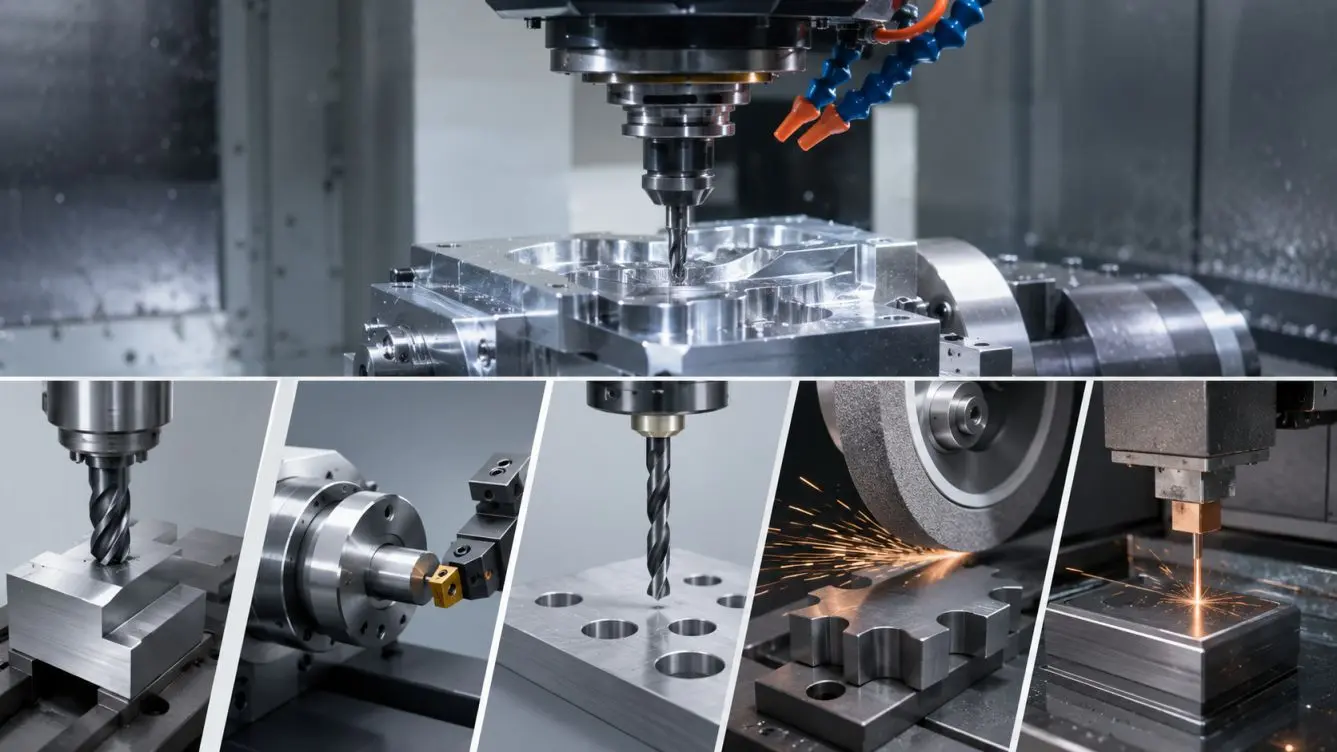
CNC machining is a family of subtractive processes that remove material from a solid workpiece under computer control. The main operations are milling, turning, drilling, grinding, and electrical discharge machining (EDM). Milling, turning, and drilling are conventional cutting operations; grinding refines finish and tolerance; EDM cuts hardened metals and complex shapes that standard tools can’t reach.
CNC machining isn’t a single method. It’s a group of operations, each built to shape a different kind of feature. A shaft needs turning. A flat face or a pocket needs milling. A hole needs drilling. A hardened bearing surface needs grinding. And a sharp internal corner in tool steel needs EDM.
Knowing what each operation does and where it stops being the right choice is how engineers and buyers specify parts that come out accurate the first time. This guide walks through the main CNC machining operations, how each one works, and when to use it.
What Are CNC Machining Operations?
A CNC machining operation is a controlled way of removing metal (or plastic) from a workpiece to reach a finished shape. CNC stands for Computer Numerical Control, which means the tool paths are driven by programmed instructions rather than a machinist turning handwheels by hand.
Every CNC operation works by subtraction. You start with a solid block, bar, or casting, and the machine cuts material away until the part matches the drawing. This is the opposite of additive methods like 3D printing, which build a part up layer by layer. Subtractive machining holds tighter tolerances and works across a much wider range of metals, which is why it remains the backbone of industrial component production.
What separates one operation from the next is how the tool and the workpiece move relative to each other. In turning, the part spins and the tool stays still. In milling, the tool spins and the part stays fixed. In drilling, a rotating bit plunges straight in. That single difference in motion decides what geometry each operation can produce.
These operations sit inside the precision machining process, which runs from drawing review through programming, machining and inspection.
Conventional vs Non-Conventional CNC Machining
CNC operations fall into two broad groups, and the split is worth understanding before looking at each one.
Conventional machining removes material by direct contact between a cutting tool and the workpiece. The tool is harder than the material and physically shears chips away. Milling, turning, drilling, and grinding all work this way. These operations are fast, cost-effective, and handle the majority of everyday machined parts.
Non-conventional machining removes material without a hard tool touching the workpiece in the usual cutting sense. EDM erodes metal with electrical sparks. Laser and waterjet cutting use a focused beam or a high-pressure stream. These methods come into play when the material is too hard for a cutting tool, or the feature is too fine or too intricate for a physical cutter to reach without breaking or deflecting.
Most real parts use a sequence. A component might be turned to its base shape, milled for flats and crossholes, drilled and tapped for fasteners, then ground on a critical sealing face. The operations are complementary, not competing.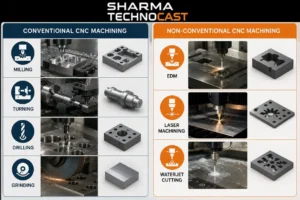
 CNC Milling
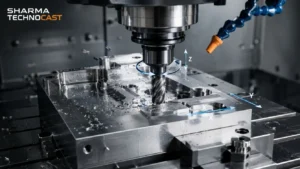
CNC milling uses a rotating multi-tooth cutter to remove material from a workpiece that’s clamped in place. The cutter moves across the part along several axes to carve flat faces, slots, pockets, and complex contours.
The two basic forms are face milling, where the cutter works across the top surface of the part, and peripheral milling, where the side of the cutter shapes the edges. Machines range from three-axis, which move the tool in X, Y, and Z, up to five-axis, which tilt and rotate to reach faces a fixed part would otherwise hide. Five-axis work is what makes deep cavities and angled features possible in a single setup, and it’s the reason 5-axis CNC machining matters for complicated components.
Milling suits flat and prismatic parts, mould tools, housings, brackets, and any component with pockets or 3D surfaces. Typical tolerances on a standard three-axis mill sit around ±0.025 mm, tightening further on precision setups. For a fuller comparison of when milling beats turning, see our guide on CNC turning vs CNC milling.
A three-axis mill holds around ±0.025 mm on general features and tightens further on critical dimensions.
CNC Turning
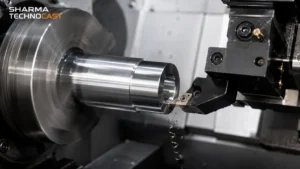
CNC turning rotates the workpiece against a single-point cutting tool that moves in a straight line. Because the part spins, turning naturally produces round shapes: shafts, pins, bushings, and any cylindrical component.
A lathe or turning center performs the work. The tool can cut external diameters, bore internal holes, cut tapers, form grooves, and thread the part, all while it rotates. Swiss turning is a variant that supports the bar very close to the cutting point, which reduces deflection and lets the machine hold tight tolerances on small, slender parts made in volume.
Turning is the right choice for anything axisymmetric. It’s fast and repeatable for high volumes of round parts. Where it stops is freeform geometry. A part with flats, off-axis holes, or complex surfaces needs milling to finish, which is why turned parts often move to a mill for secondary features.
CNC Drilling
CNC drilling produces holes with a rotating drill bit that plunges into the material. The bit’s spiral flutes clear the chips out of the hole as it cuts deeper. The CNC program controls the position, depth, and feed precisely, so hole locations stay accurate across a batch.
Drilling covers more than plain holes. Peck drilling pulls the bit out repeatedly to clear chips on deep holes. Spot drilling starts an accurate centre before a full drill. Gun drilling handles deep holes where the depth is more than about ten times the diameter and straightness matters. Drilling is usually the first step before tapping, reaming, or boring, which bring a hole to a threaded form or a tighter final size.
Holes are found in almost every machined part, so drilling appears across fixtures, housings, engine components, flanges, and valve bodies. Its limit shows up when tolerances get very tight or the geometry gets complex, at which point milling, reaming, or EDM take over.
CNC Grinding
CNC grinding uses an abrasive wheel instead of a cutting tool. The wheel spins at high speed and removes a very thin layer of material with each pass, which is what lets grinding reach fine surface finishes and tolerances that milling or turning can’t hold.
Grinding is a finishing operation. It comes in after the rough shape is cut, usually to correct a dimension or improve a surface. There are several forms: cylindrical grinding for round parts, surface grinding for flats, internal grinding for bores, and centerless grinding for high volumes of small cylindrical parts. Because the wheel is abrasive rather than a single hard edge, grinding also works on hardened steel that would blunt a normal cutter.
Use grinding when a part needs single-digit-micron tolerance or a mirror finish, especially on bearing seats, sealing faces, and hardened surfaces. It’s slower and more costly per part than cutting, so it’s reserved for the features that genuinely need it rather than the whole component.
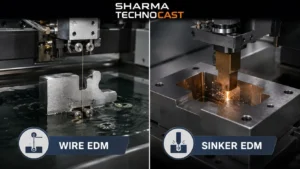 Electrical Discharge Machining (EDM)
EDM removes metal using controlled electrical sparks between an electrode and the workpiece, both submerged in a dielectric fluid. The sparks erode the material away. Because nothing hard actually presses against the part, EDM cuts metals regardless of hardness, and it produces features a cutting tool couldn’t survive.
There are two main types. Wire EDM uses a thin electrically charged wire to cut precise profiles right through the material, ideal for intricate 2D shapes and tight internal corners. Sinker EDM (also called die-sink) uses a shaped electrode to burn a matching cavity into the part, which is how blind cavities and detailed mould features get made.
EDM earns its place on hardened tool steel and carbide, deep narrow slots, sharp internal corners, and complex cavities that milling can’t reach without tool deflection. The trade-off is speed. EDM is slower than conventional cutting, so it’s chosen for the geometry and material rather than for throughput.
Other CNC Operations
Beyond the five main operations, a few others handle specific jobs. Boring enlarges and trues an existing hole to a precise diameter. Broaching pushes a toothed tool through or across a part to cut internal splines, keyways, and non-round holes in one stroke. On the non-conventional side, laser, plasma, and waterjet cutting shape flat stock: laser for fine, clean cuts in thinner material, plasma for faster cutting of conductive metals, and waterjet for thick or heat-sensitive materials that shouldn’t be exposed to a hot cutting zone.
How to Choose the Right CNC Machining Operation
The right operation depends on the part in front of you, not on which machine is fastest in the abstract. Four factors decide it: the geometry, the tolerance, the material, and the volume.
Match the operation to the shape first. Round parts go to turning. Flat faces, pockets, and 3D surfaces go to milling. Holes go to drilling. Then look at tolerance and finish: if a surface needs to be finer than cutting can hold, add grinding. If the material is hardened or the feature is a sharp internal corner, use EDM.
Where the part is a one-off or the geometry is impossible to cut, it is worth weighing the operation against 3D printing before committing to tooling.
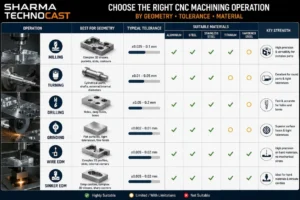
Here’s a quick reference:
| Operation | Best for | Typical tolerance |
| Milling | Flat faces, pockets, 3D surfaces | ±0.025 mm |
| Turning | Cylindrical parts, shafts, bores | ±0.025 mm |
| Drilling | Holes, hole patterns | ±0.05 mm |
| Grinding | Fine finish, hardened surfaces | ±0.005 mm or better |
| EDM | Hardened metals, complex cavities | ±0.005 mm |
Most components combine two or three operations in sequence. A single part rarely relies on one alone, so the practical skill is planning the order: rough shape first, features next, finishing last.
CNC Machining Services at Sharma Technocast
Sharma Technocast runs CNC milling, turning, and multi-axis machining at its Ahmedabad facility, producing components for OEM and industrial applications across India and export markets. Because casting, forging, and machining all sit under one roof, machined parts can start from our own castings and forgings and finish to accurate final dimensions without moving between suppliers. If you have a component to machine, send the drawing with your material, tolerance, and quantity, and our team will match the right operations to it. For more on our capabilities, see our precision machining services.
FREQUENTLY ASKED QUESTIONS
Q1. What are the main types of CNC machining operations?
The main CNC machining operations are milling, turning, drilling, grinding, and electrical discharge machining (EDM). Milling, turning, and drilling are conventional cutting operations, grinding is a finishing operation, and EDM is a non-conventional process for hardened materials and complex shapes.
Q2. What is the difference between CNC milling and CNC turning?
In CNC milling, the cutting tool rotates and the workpiece stays fixed, which suits flat faces, pockets, and complex shapes. In CNC turning, the workpiece rotates against a fixed tool, which suits cylindrical parts like shafts and bushings.
Q3. What is the difference between conventional and non-conventional machining?
Conventional machining removes material by direct contact with a hard cutting tool, as in milling, turning, drilling, and grinding. Non-conventional machining removes material without conventional cutting, such as EDM using electrical sparks or laser and waterjet cutting, and is used for very hard materials or intricate features.
Q4. Which CNC operation is best for tight tolerances?
Grinding and EDM hold the tightest tolerances, often to single-digit microns. Standard milling and turning typically hold around ±0.025 mm, so parts needing a finer finish or dimension are usually ground or EDM-cut after the main cutting is done.
Q5. What is EDM used for?
EDM is used to cut hardened metals like tool steel and carbide, and to produce features such as sharp internal corners, deep narrow slots, and complex cavities that cutting tools can’t machine without deflecting or breaking. Wire EDM cuts profiles; sinker EDM burns cavities.
Q6. How do I choose the right CNC machining process?
Choose based on part geometry, tolerance, material, and volume. Use turning for round parts, milling for flat or complex surfaces, and drilling for holes. Add grinding for fine finishes and EDM for hardened or intricate features. Most parts use a combination of operations in sequence.