

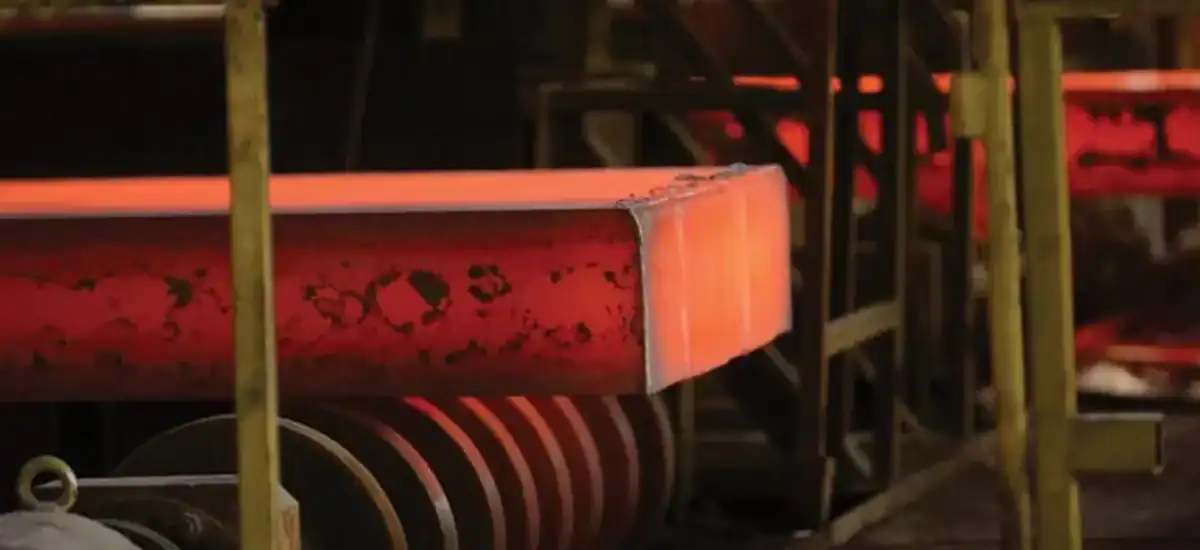
Short answer: closed die forging presses hot steel into a die cavity shaped like the finished part, so every part comes out near-net shape and the same as the last. It suits repeat parts in small and medium sizes: flanges, hubs, gear blanks, valve and oilfield parts. We do it at our forging facility on a 1,250 T press, screw press and 1.5–4.5 T drop hammer lines, with our own die shop, heat treatment, testing and machining.
What is closed die forging?
Closed die forging, also called impression die forging, shapes heated metal between two dies that carry the impression of the finished part. The billet is placed in the lower die and struck or pressed; the metal flows to fill the cavity, and a little escapes around the parting line as flash, which is trimmed off afterwards.
Because the die, not the operator, sets the shape, parts repeat accurately once the die is proven. That is the difference from open die forging, where flat dies and a manipulator build the shape stroke by stroke. Both are routes within the wider forging process.
Closed die forging at Sharma Technocast
1,250 T press and screw press line
Press forging of repeat parts where controlled squeeze and accurate die closure matter.
1.5–4.5 T drop hammer lines
Impression die forging of small and medium parts in volume.
Hammers and roll forging for preforms
10 MT steam hammer, 6 T pneumatic hammer line and a roll forging line distribute the metal before the finishing die.
Own die shop
Die design and manufacture for your part, so die changes and repairs stay under one roof.
Heat treatment
Gas-fired furnaces with polymer and oil quench tanks: normalising, quenching and tempering.
Testing and machining
Testing for every heat, and machining to the drawing, with material test certificates and dimensional reports.
Part outside the closed die range? Large shafts, rings and blocks up to 30 t go to our heavy open die forging presses instead. Send the drawing and we confirm the right route within 24–48 hours.
How the closed die forging process works
- Die design. We draw the forging from your finished-part drawing: parting line, draft angles, radii, flash and machining stock. You approve the forging drawing before the die is cut.
- Cut and heat the billet. Stock is cut to weight and heated to forging temperature, typically about 1,100–1,250 °C for carbon and alloy steels.
- Preform. Fullering, edging or roll forging moves the metal to where the part needs it.
- Blocker and finisher. A blocker impression gives the rough shape; the finisher impression sets the final dimensions.
- Trim. Flash is sheared off in a trimming press.
- Heat treat, test, machine. Normalising or quench and temper, testing for every heat, then machining and inspection.
Materials we forge in closed dies
| Material family | Grades | Typical closed die parts |
|---|---|---|
| Carbon steel | EN8; ASTM A105; ASTM A350 LF2 (low temperature) | Flanges, fittings, valve bodies, shafts |
| Cr-Mo alloy steel | EN19, EN24; AISI 4130, 4140, 4340; ASTM A182 F11, F22 | Oilfield and wellhead parts, gear blanks, hubs, studs, high-temperature fittings |
| Stainless steel | ASTM A182 F304, F316; F51 duplex | Flanges and fittings for corrosive, seawater and chloride service |
| Tool steel | Hot die steels | Die blocks and tooling |
| Aluminium | 6061 | Lightweight hubs and housings |
Other grades are forged to your specification. To choose between them, read our guide to A105, F22, 4130, 4140 and F51 forgings.
Designing a part for closed die forging
- Draft angles: faces in the direction of die opening need draft, usually about 3–7° on steel, so the part releases from the die.
- Radii: generous corner and fillet radii help the metal fill the die and extend die life.
- Parting line: placed so the part can leave both halves of the die; it also decides where the flash line sits.
- Machining stock: left only on faces that are machined, so the forging stays as light as possible.
- Tolerances: steel die forgings are commonly specified to EN 10243-1; tell us if your drawing uses a different standard. See forging tolerances.
Closed die or open die: how to choose
| Question | Closed die | Open die |
|---|---|---|
| Quantity | Repeat batches and series | One-offs and small batches |
| Part size | Small and medium, limited by press and die size | Up to 30 t: shafts Ø 2,000 × 16,000 mm, rings Ø 3,000 mm |
| Tooling | Part-specific die (one-off cost) | No part-specific die |
| Machining | Less stock, shorter machining | More stock on every face |
More detail: open die vs closed die forging.
Where closed die forgings are used
- Oil and gas: flanges, valve bodies, hubs, union and wellhead parts made to API 6A dimensions.
- Power and process plants: high-temperature fittings and flanges in F22.
- Heavy engineering and mining: gear blanks, couplings, hubs, levers.
- Automotive and railway: forged parts to OEM drawings.
Get a quote
Send us the finished-part drawing, material grade, heat treatment and properties, testing required and your yearly quantity. We reply with the forging route (closed die, open die or machining), the die cost if needed, and the price per part. Typical lead time is 4 to 6 weeks from drawing approval.
Sharma Technocast · ISO 9001:2015 certified · Established 2013 · 15+ years of group experience in forging · All forging services
Closed die forging FAQ
What is closed die forging?
Closed die forging, also called impression die forging, presses or hammers hot metal into a cavity cut into a pair of dies. The metal fills the cavity, a thin flash escapes at the parting line and is trimmed off, and the part comes out close to its finished shape. It is used for repeat parts that need consistent dimensions and forged strength.
When is closed die forging better than open die forging?
When the same part repeats in quantity and is small or medium in size. The die is a one-off cost, but every part after that needs less material, less machining and comes out the same. For very large parts, one-offs or small batches, open die forging is usually cheaper because no part-specific die is needed.
What equipment do you use for closed die forging?
Our forging facility runs a 1,250 T press, a screw press line and 1.5–4.5 T drop hammer lines for closed die work, with a 10 MT steam hammer, a 6 T pneumatic hammer line and a roll forging line for preforms, and its own die shop for die design and manufacture.
Which materials can be closed die forged?
Carbon, alloy and stainless steels to EN, AISI, ASTM, SAE and IS standards, including EN8, EN19 and EN24, AISI 4130, 4140 and 4340, ASTM A105 and A350 LF2, ASTM A182 F11, F22, F304, F316 and F51 duplex, and hot die steels. We have also forged and machined aluminium 6061 parts. Other grades are forged to your specification.
What tolerances does closed die forging hold?
Closer than open die forging, so less machining stock is needed. Steel die forgings are commonly specified to EN 10243-1; we forge to the tolerances and machining allowances on your drawing and agree the forging drawing with you before the die is made.
Who owns the die and what does it cost?
Die cost depends on the size and complexity of the part, so it is quoted separately with the first order. Tell us your yearly quantity and we will compare the die route with open die forging and machining, so you can see which is cheaper for your volume.
What is the lead time for closed die forgings?
Typically 4 to 6 weeks from drawing approval, depending on size, material, die requirements, heat treatment and machining. A new die adds time to the first order; repeat orders run on the existing die. We confirm a firm schedule with every quotation.
Do you heat treat, test and machine closed die forgings?
Yes. Forgings are normalised or quenched and tempered, tested for every heat (chemical analysis, tensile, impact, hardness, and UT, MPI or DPT as required) and supplied as forged or machined to the drawing, with material test certificates and dimensional reports.