

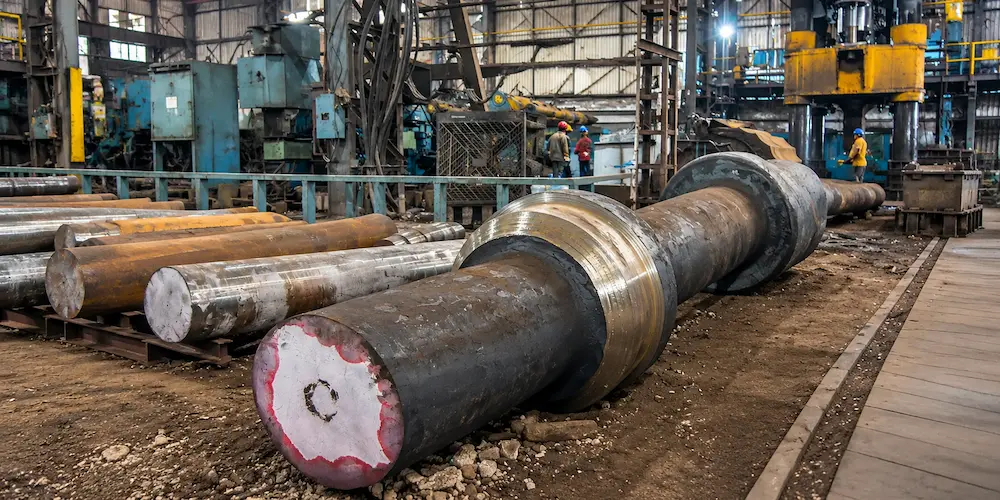
Short answer: five grades cover most forged pressure and power-transmission parts. ASTM A105 is the carbon steel for flanges, fittings and valve bodies in general service. ASTM A182 F22 (2¼Cr-1Mo) is for high-temperature and hydrogen service. AISI 4130 is the usual quenched-and-tempered steel for API 6A wellhead and frac equipment. AISI 4140 is chosen when you need higher strength, as in shafts, gears and B7 studs. ASTM A182 F51 (duplex 2205) is for seawater and chloride service. Choose by service temperature, pressure, corrosion and the code your part must meet, then write the grade, class and heat treatment into the RFQ.
We forge all five grades at our forging facility and machine them in our own shop, so this guide is written from the questions buyers actually ask us. It covers what each grade is, its chemistry and minimum properties, the heat treatment it needs, and the parts it is normally used for.
The Five Grades at a Glance
| Grade | Type | Min. yield / tensile (MPa) | Typical parts |
|---|---|---|---|
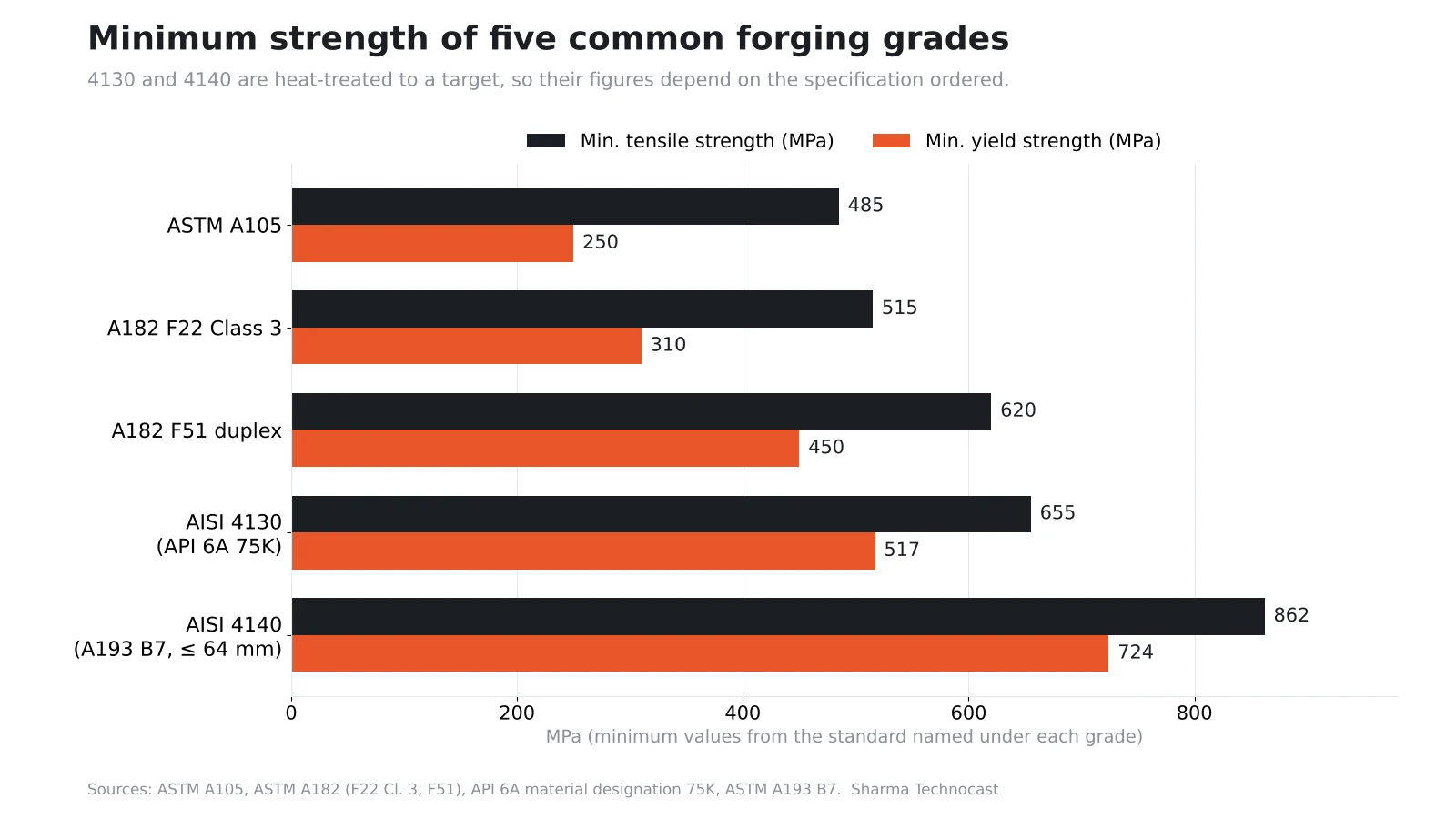
| ASTM A105 | Carbon steel | 250 / 485 | Flanges, fittings, valve bodies |
| A182 F22 Cl. 3 | 2¼Cr-1Mo alloy | 310 / 515 | High-temperature flanges, nozzles |
| AISI 4130 | Cr-Mo alloy, Q&T | 517 / 655 (API 6A 75K) | Wellhead and frac valve bodies |
| AISI 4140 | Cr-Mo alloy, Q&T | 724 / 862 (A193 B7) | Shafts, gears, studs |
| A182 F51 | Duplex 2205 | 450 / 620 | Offshore flanges, seawater parts |
Heat treatment: A105 as forged or normalized; F22 normalized and tempered (or quenched and tempered); 4130 and 4140 quenched and tempered to the specification you order; F51 solution annealed and water quenched. Each is explained below.
ASTM A105: Carbon Steel for General Pressure Service
A105 is the standard specification for carbon steel forgings for piping components: flanges, fittings, valve bodies and similar parts for ambient and moderate-temperature service. It is the default material for ASME B16.5 and B16.11 carbon steel flanges and fittings.
| Element | Limit (%) |
|---|---|
| Carbon | 0.35 max |
| Manganese | 0.60 to 1.05 |
| Silicon | 0.10 to 0.35 |
| Phosphorus / Sulphur | 0.035 max / 0.040 max |
| Chromium / Molybdenum / Nickel (residuals) | 0.30 / 0.12 / 0.40 max |
Minimum properties: tensile 485 MPa (70 ksi), yield 250 MPa (36 ksi), elongation 22%, reduction of area 30%, hardness 187 HBW max.
Heat treatment: forgings up to NPS 4 may be supplied as forged; larger forgings must be heat treated. Many project specifications ask for normalizing on all sizes, and for sour service A105 is usually supplied normalized with hardness kept within the NACE MR0175 / ISO 15156 limit.
ASTM A182 F22: 2¼Cr-1Mo for Heat and Hydrogen
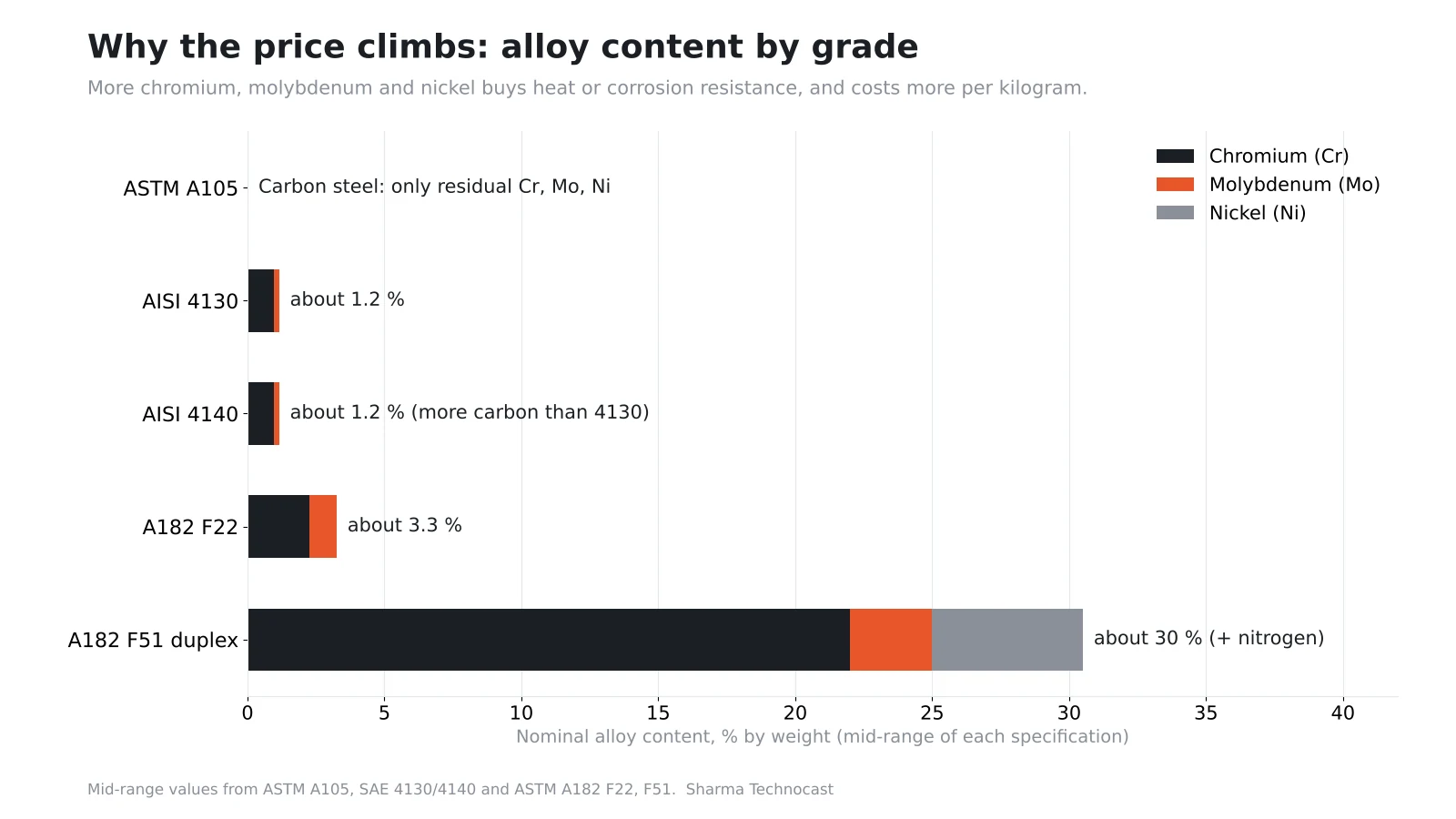
F22 adds about 2.25% chromium and 1% molybdenum. Chromium resists oxidation and hydrogen attack; molybdenum keeps strength at temperature. That is why F22 is used for refinery hydroprocessing units, steam lines and power-plant parts, for service up to about 595 °C (1,100 °F).
| Element | Range (%) |
|---|---|
| Carbon | 0.05 to 0.15 |
| Manganese | 0.30 to 0.60 |
| Chromium | 2.00 to 2.50 |
| Molybdenum | 0.87 to 1.13 |
| Silicon | 0.50 max |
Classes: F22 comes in two strength classes. Class 3 (tensile 515 MPa / 75 ksi, yield 310 MPa / 45 ksi, elongation 20%, reduction of area 30%) is the usual choice for piping and pressure parts. Class 1 (tensile 415 MPa / 60 ksi, yield 205 MPa / 30 ksi) is specified much less often. Always state the class on the drawing or order.
Heat treatment: normalized and tempered, or quenched and tempered. Welds on F22 need preheat and post-weld heat treatment, so tell your forging supplier if the part will be welded.
AISI 4130: The Oilfield Workhorse
4130 is a low-alloy chromium-molybdenum steel with about 0.30% carbon. It hardens well through the section, welds better than 4140, and can be heat treated to a controlled strength and hardness. That makes it the most common body material for API 6A wellhead and frac equipment: valve bodies, bonnets, adapters, spools, hammer unions and pup joints.
| Element | Range (%) |
|---|---|
| Carbon | 0.28 to 0.33 |
| Manganese | 0.40 to 0.60 |
| Chromium | 0.80 to 1.10 |
| Molybdenum | 0.15 to 0.25 |
| Silicon | 0.15 to 0.35 |
Properties are set by the specification you order. For API 6A parts, ask for a material designation: 60K (minimum yield 414 MPa / 60,000 psi) or 75K (minimum yield 517 MPa / 75,000 psi) are typical for 4130 bodies. For sour service (API 6A material classes DD to HH), NACE MR0175 / ISO 15156 limits carbon and low-alloy steels to 22 HRC maximum, so the tempering is set to meet both the strength and the hardness cap. Read more in our guide to API 6A pressure ratings, temperature classes and PSL.
AISI 4140: When You Need More Strength
4140 has the same chromium and molybdenum as 4130 but about 0.40% carbon, so it reaches higher strength and hardness after quenching and tempering. It is the usual choice for shafts, gears, pinions, collars and high-strength studs. Its weldability is poorer than 4130, so it is best for parts that are machined rather than welded.
| Element | Range (%) |
|---|---|
| Carbon | 0.38 to 0.43 |
| Manganese | 0.75 to 1.00 |
| Chromium | 0.80 to 1.10 |
| Molybdenum | 0.15 to 0.25 |
| Silicon | 0.15 to 0.35 |
Example specification: ASTM A193 B7 studs. Up to 64 mm (2½ in) diameter: tensile 862 MPa (125 ksi), yield 724 MPa (105 ksi), elongation 16%, reduction of area 50%, hardness 321 HBW / 35 HRC max, tempered at 593 °C (1,100 °F) minimum. Larger diameters have lower minimums, because thick sections cool more slowly when quenched. The same is true of large 4140 forgings: tell your supplier the finished section size, so the heat treatment can reach the required properties at the core, not just at the surface.
ASTM A182 F51: Duplex Stainless for Chlorides
F51 is duplex stainless steel 2205 (UNS S31803): roughly half austenite and half ferrite. It is about twice as strong as 316 stainless steel and far more resistant to chloride pitting and stress corrosion cracking, which is why it is used for offshore piping flanges, manifold blocks, seawater and fire-water systems.
| Element | Range (%) |
|---|---|
| Chromium | 21.0 to 23.0 |
| Nickel | 4.5 to 6.5 |
| Molybdenum | 2.5 to 3.5 |
| Nitrogen | 0.08 to 0.20 |
| Carbon | 0.030 max |
| Manganese / Silicon | 2.00 max / 1.00 max |
Minimum properties: tensile 620 MPa (90 ksi), yield 450 MPa (65 ksi), elongation 25%. Its pitting resistance equivalent number (PREN) is about 34 to 36.
Heat treatment: solution annealed at 1,020 to 1,100 °C and water quenched, to keep the austenite-ferrite balance and avoid harmful phases. Buyers often ask for a ferrite count and a corrosion test (such as ASTM G48) on the certificate. Duplex is not used for long periods above about 250 °C, where it loses toughness.
How to Choose the Right Grade
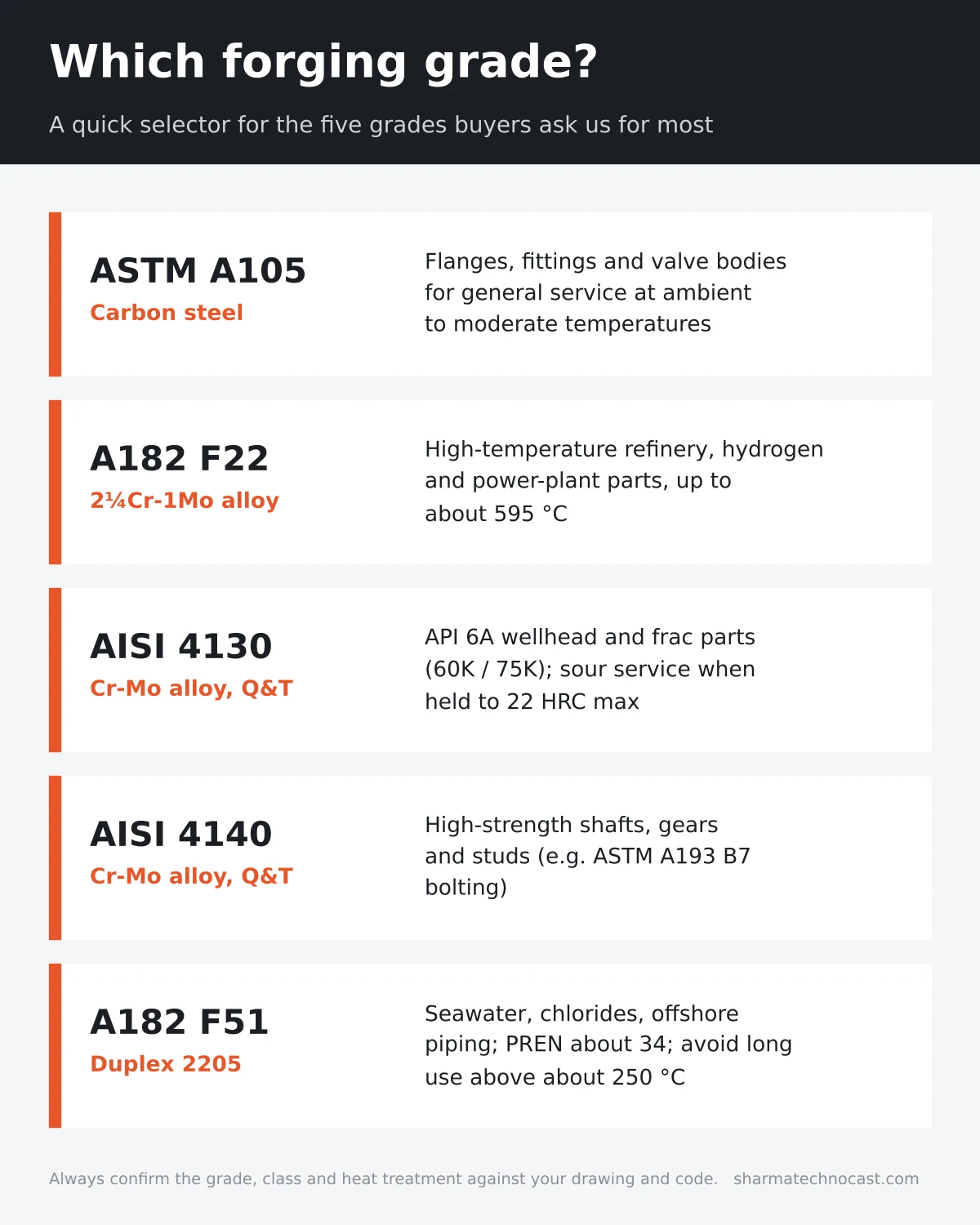
- Ambient to moderate temperature, general pressure service: A105. It is the cheapest and easiest to source.
- High temperature or hydrogen service: F22 Class 3, or another Cr-Mo grade your code calls for.
- API 6A wellhead, frac and pressure-control parts: 4130 quenched and tempered to 60K or 75K, held to 22 HRC max for sour service.
- High strength, wear or fatigue (shafts, gears, studs): 4140 quenched and tempered, sized for the section.
- Seawater, chlorides or offshore: F51 duplex.
- Low-temperature service: ask for impact (Charpy) testing at your minimum design temperature. Some codes call for a different grade, such as ASTM A350 LF2 instead of A105.
What to Put in Your RFQ
- Specification, grade and class, for example “ASTM A182 F22 Class 3”, not just “F22”.
- Heat treatment and target properties: normalized, normalized and tempered, or quenched and tempered, with the yield, tensile and hardness you need (or the API 6A material designation).
- Service conditions: sour service (NACE MR0175 / ISO 15156), low temperature (impact test temperature), or high temperature.
- Testing and documents: mill and forging test certificates to EN 10204 3.1, ultrasonic testing, MPI or dye penetrant, and any third-party inspection.
- Drawing, quantity and finished condition: rough forged, proof machined or fully machined.
How Sharma Technocast Supplies These Grades
We forge A105, F22, 4130, 4140 and F51 at our forging facility: open die forgings up to 30 t, rings and flanges up to Ø 3,000 mm, and closed die forgings. Heat treatment is matched to the grade and section size, and chemical, mechanical and ultrasonic testing is done for every heat. Parts can be shipped rough forged or machined in our own machine shop, with material test certificates and dimensional reports. Recent work includes 4140 banjo gears and studs, and 4340 bearing nuts and plugs, all forged and machined.
Have a drawing? Send your RFQ with the grade, class and quantity, and we will confirm the material route and lead time within 24 to 48 hours.
Frequently Asked Questions
What is the difference between 4130 and 4140?
Both are chromium-molybdenum steels. 4140 has more carbon (about 0.40% against 0.30%), so it reaches higher strength and hardness after heat treatment, while 4130 welds more easily. 4130 is common for API 6A pressure bodies; 4140 is common for shafts, gears and B7 studs.
Is A105 suitable for sour service?
Yes, when it meets NACE MR0175 / ISO 15156. That normally means normalized material with hardness kept at 187 HBW (22 HRC) or below, and the welds controlled to the same limits.
What does F22 Class 3 mean?
F22 is the 2¼Cr-1Mo grade in ASTM A182. Class 3 is the higher-strength class, with a minimum tensile strength of 515 MPa (75 ksi) and yield of 310 MPa (45 ksi). Class 1 has 415 MPa (60 ksi) tensile and 205 MPa (30 ksi) yield.
Is F51 the same as duplex 2205?
Yes. ASTM A182 F51 is the forging grade of duplex stainless steel UNS S31803, commonly called 2205. Some buyers specify the tighter S32205 chemistry (F60), so check which one your drawing calls for.
Which steel is used for API 6A wellhead forgings?
Most API 6A bodies and bonnets are forged from AISI 4130 (or a modified 4130), quenched and tempered to material designation 60K or 75K. For sour service the hardness is kept at 22 HRC or below to meet NACE MR0175 / ISO 15156.
Can you forge and machine these grades in one order?
Yes. We forge all five grades, heat treat them, and finish-machine them in our own machine shop, so one supplier handles the forging, testing, machining and inspection.