

What is metal forging?
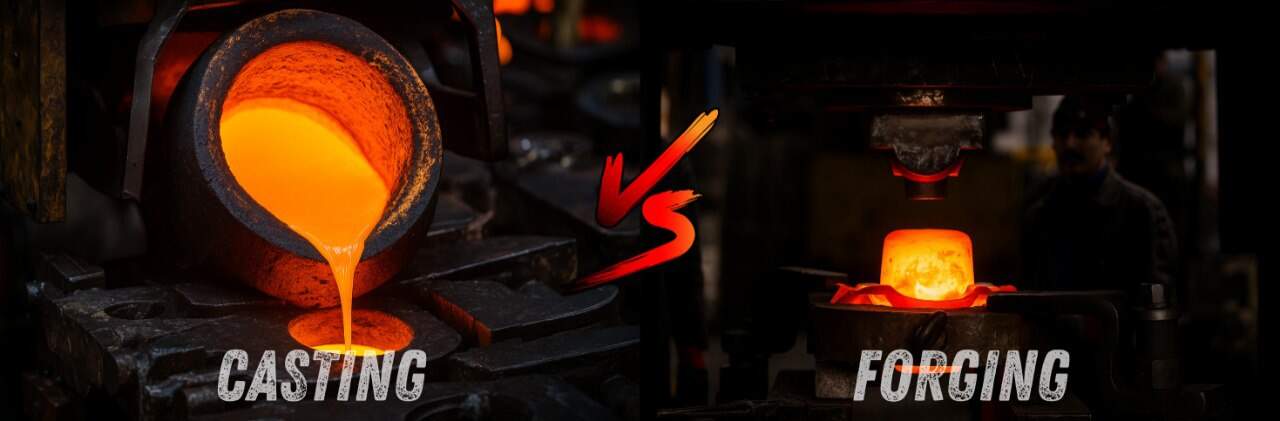
Unlike casting, forging shapes metal in its solid state using compressive forces delivered by hammers, presses or rollers. This controlled deformation refines the internal grain structure of the metal, making it stronger and tougher.
Forging Advantages:
- Superior Strength: Forged parts are denser and more reliable for critical applications.
- Durability: Excellent fatigue, impact and wear resistance.
- Structural Integrity: Minimizes voids and internal defects compared to casting.
- High-Performance Applications: Preferred for aerospace, automotive and material handling industries.
Our forging services offer open die forging, closed die forging, and roll forging solutions to meet global standards of performance and reliability.
Metal Casting vs Metal Forging
| Factor | Metal Casting |
Metal Forging |
| Shape Complexity | Excellent for complex shapes and internal features | Limited, but strong and consistent |
| Mechanical Properties | Good, but less robust than forging | Superior strength, durability, and fatigue resistance |
| Dimensional Precision | High accuracy with die or investment casting | High consistency with closed-die forging |
| Material Range | Wide selection of metals and alloys | Limited by forgeability |
| Cost Efficiency | More economical for complex, low-to-medium volume parts | Cost-effective for medium-to-high volumes |
Making the Right Choice
Casting or Forging?
- Choose casting if you need complex shapes, large parts, or flexibility in materials.
- Choose forging if your application demands high strength, toughness, and long-term reliability.
Often these processes are complemented by precision machining to achieve exact dimensions and smooth finishes. At Sharma Technocast we integrateCNC machiningwith both casting and forging to deliver ready-to-use, high-quality components.
Casting also carries a risk profile that forging does not. Porosity and shrinkage are inherent to solidification, so casting defects have to be designed out at the gating stage rather than inspected out at the end.
Why Partner with Sharma Technocast?
Sharma Technocast is more than just a manufacturer—we are a complete engineering solutions provider. We have expertise in metal casting, forging, precision machining, fastener manufacturing, and fabrication services. With modern facilities and stringent quality control, we serve industries worldwide with high-performance components.
Whether you need industrial conveyor rollers, pipe bending services, or customized fasteners, our team ensures every component meets international standards.
Both metal casting and forging are essential in industrial manufacturing. Casting offers design flexibility and material diversity, while forging delivers unmatched strength and durability. The right choice depends on your component’s design, application, and performance requirements.
At Sharma Technocast we provide both processes under one roof along with advanced machining and fabrication to ensure your components are delivered with precision and reliability.
Looking for a trusted partner for your next project? Explore our metal casting and forging services today.