

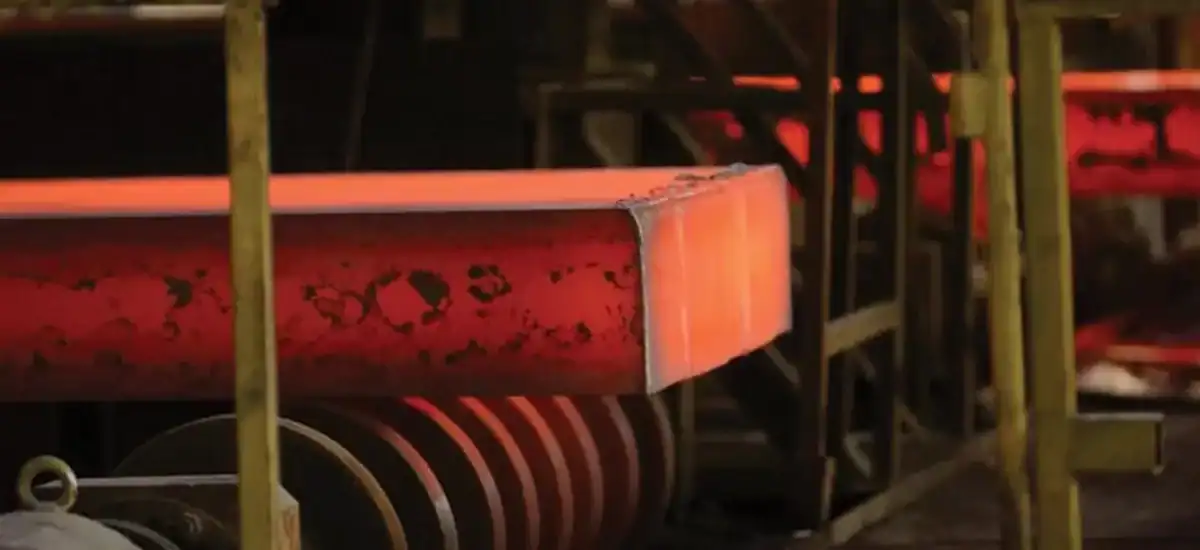
Closed Die Forging
Closed die forging, also called impression die forging, shapes heated metal between two dies that fully enclose the workpiece. The dies carry the impression of the finished component, so the metal is forced to fill the cavity under pressure. It holds tighter tolerances than open die forging and suits repeat production rather than one-off parts.
What Is Closed Die Forging?
Closed die forging shapes metal between two dies that carry the impression of the finished part. Heated stock is placed in the lower die and struck or pressed, forcing the metal to fill the cavity. Excess material escapes around the parting line as flash, which is trimmed away afterwards.
It sits within the wider forging process alongside open die and roll forging, and it is the route used when the same component has to repeat accurately across a production run.
Because the die controls the geometry rather than the operator, closed die work produces consistent parts once the tooling is proven. That repeatability is why it became the standard choice for automotive and industrial components made in quantity.
How the Closed Die Forging Process Works
Stock is cut to weight, heated to forging temperature (typically between 1,100°C and 1,250°C for carbon and alloy steels) and passed through a sequence of die impressions rather than formed in a single blow.
- Preform. Fuller and edger impressions redistribute the material along the billet so the metal sits roughly where the finished part needs it.
- Blocker. A rough version of the final shape with generous radii, letting the metal flow without folding over itself.
- Finisher. The final impression, which sets the dimensions and surface detail.
- Trimming. Flash is sheared away in a separate press.
- Post-forging. Heat treatment, shot blasting and any machining the drawing calls for.
The dies carry the impression of the finished part, which is the main difference from open die forging where the metal is free to spread sideways between flat or simply contoured tools.
Draft angles are built into the die faces so the part releases cleanly, usually between 3 and 7 degrees on steel. Anyone designing a component for closed die forging has to allow for them at the drawing stage.
Advantages of Closed Die Forging
Grain flow follows the contour of the part. Because the metal is worked into shape rather than cut away from bar stock, the internal structure runs along the component’s loaded direction. That improves fatigue resistance and toughness compared with a machined equivalent in the same material.
Dimensional consistency. Closed die work holds much tighter bands than open die forging, so less stock is left on for machining and secondary operations shorten. The forging tolerances each process achieves determine how much material has to come off afterwards.
Surface finish comes off better than open die work, and the process produces very little waste beyond the flash, most of which goes back into the melt.
Limitations
Tooling is the constraint. Dies are expensive to cut and have a finite life, so the cost has to spread across enough parts to justify it. For one-off components or very small batches, open die forging or machining from solid usually works out cheaper even though the finished part is weaker.
Part size is limited by press capacity and die size. Very large sections go to open die forging instead.
Complex geometry with deep pockets or undercuts either cannot be forged at all or needs machining afterwards, because the metal has to flow into the cavity and the part has to come back out of it.
Where a component could reasonably go either way, we have set out open die and closed die forging compared, including the volume at which tooling cost starts to pay back.
Applications of Closed Die Forging
Automotive: connecting rods, crankshafts, steering knuckles, hubs, gear blanks
Oil and gas: valve bodies, flanges, couplings, wellhead components
Heavy engineering: shafts, lifting hooks, coupling halves, sprocket blanks
Aerospace: structural fittings and brackets where fatigue life governs the design
General industrial: hand tools, spanners, chain links, agricultural components
Materials commonly forged this way include carbon steel, alloy steels such as EN8, EN19 and EN24, stainless grades, brass and aluminium alloys.
Closed Die Forging at Sharma Technocast
Sharma Technocast runs closed die forging alongside open die and roll forging as a forging manufacturer in Ahmedabad, with heat treatment and CNC machining on the same site.
Working to customer drawings, we handle die design and manufacture, forging, trimming, heat treatment and finish machining. One material certificate follows the component from billet through to dispatch rather than the job moving between suppliers. Work is carried out under ISO 9001 and AS9100 certification.
If you have a drawing to price, our team can advise whether closed die forging is the right route for the quantity and geometry involved.