

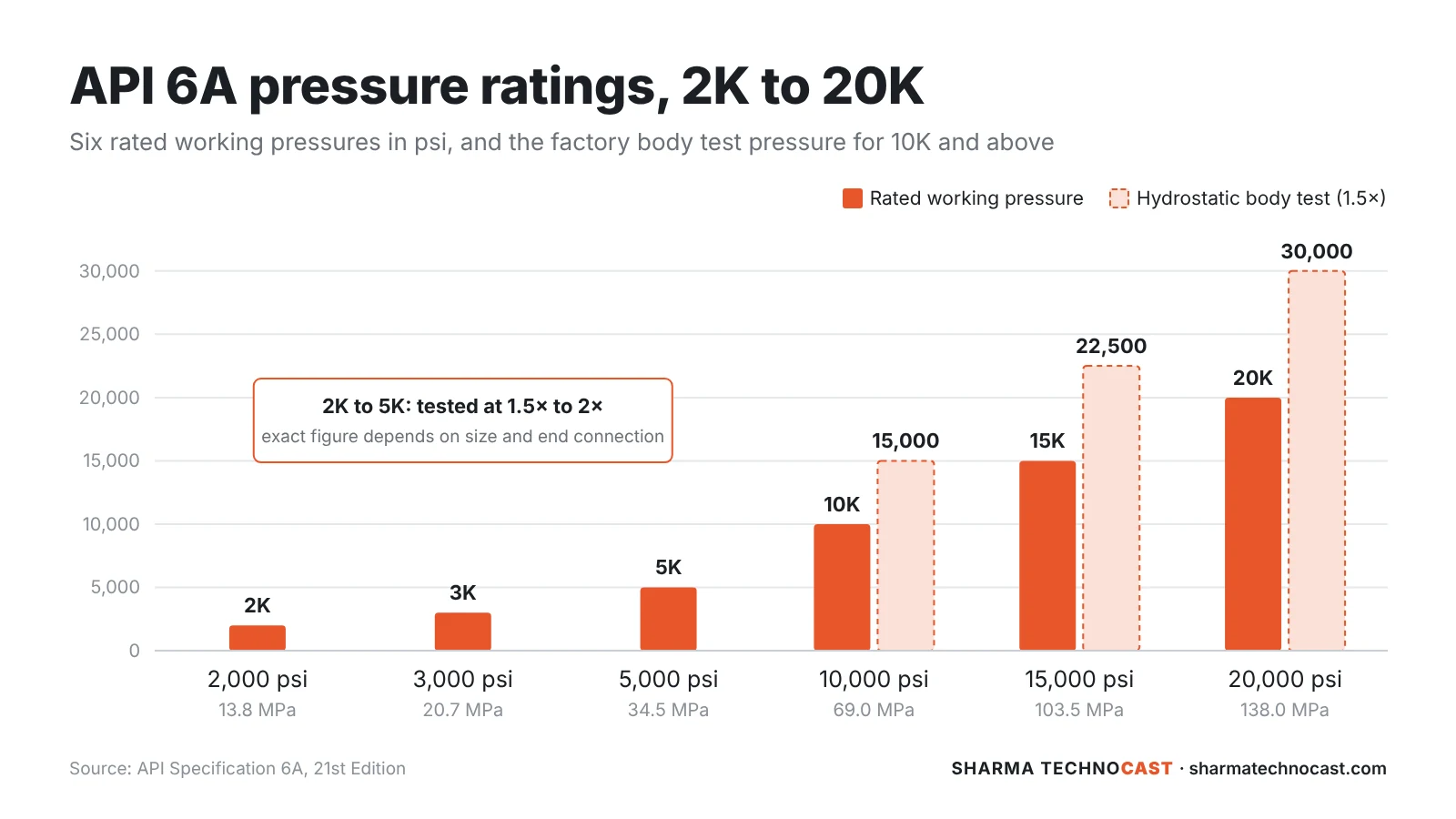
Short answer: API Specification 6A recognises six rated working pressures for wellhead and tree equipment: 2,000, 3,000, 5,000, 10,000, 15,000 and 20,000 psi (13.8 to 138 MPa). The rating is the highest pressure the equipment may see in service. Before shipment, the body is hydrostatically tested above that figure: at 1.5 times the rating for 10,000 psi and up (15,000, 22,500 and 30,000 psi), and at 1.5 to 2 times for the lower ratings, depending on size and end connection.
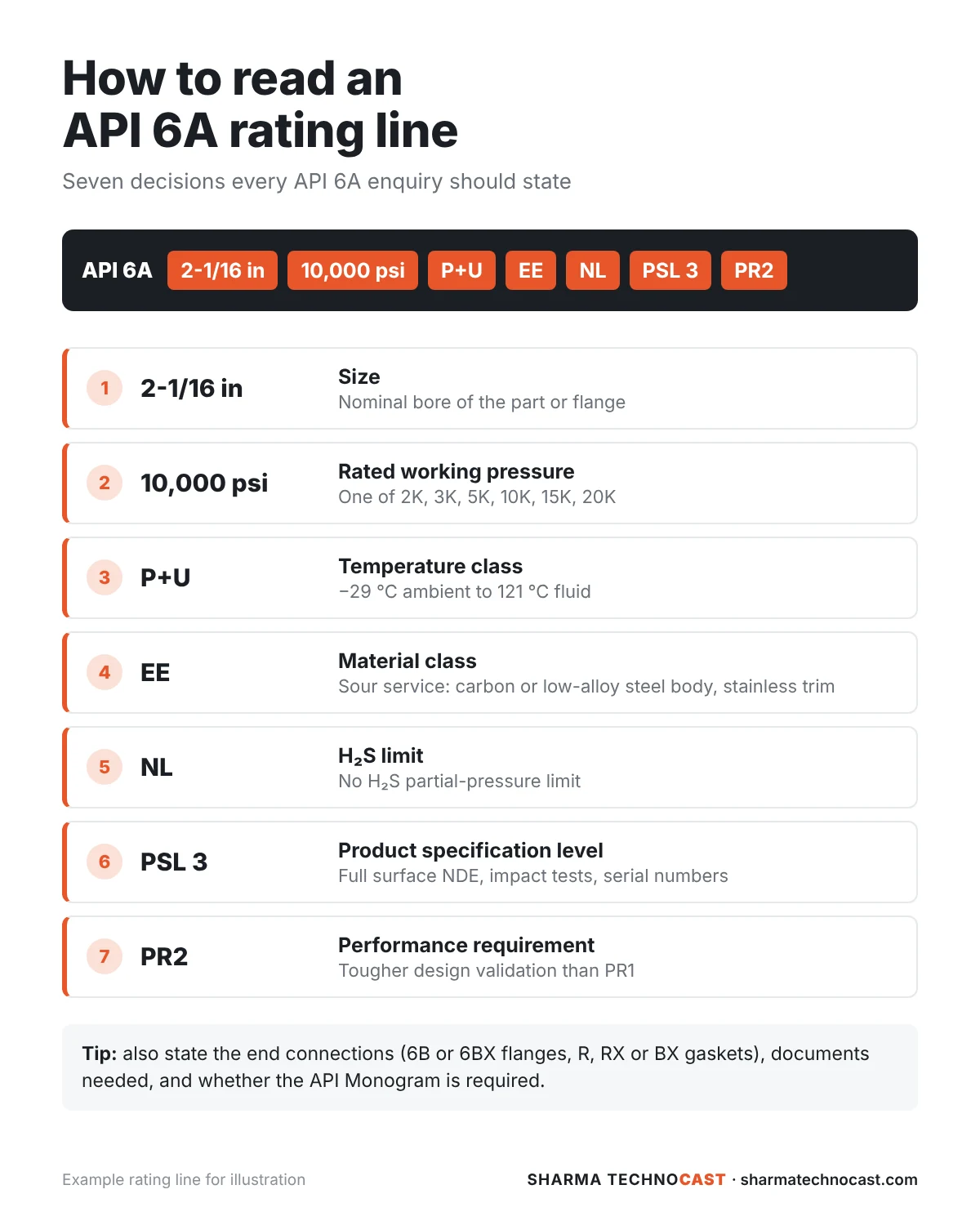
The pressure rating is only one line of an API 6A specification, though. A part also has a temperature class, a material class, a product specification level (PSL) and a performance requirement (PR). If any of these is missing from your enquiry, two suppliers can quote two quite different parts under the same “10K” label. This guide explains each one and ends with a checklist you can copy into your next RFQ.
The Six API 6A Pressure Ratings
| Rated working pressure (psi) | MPa | bar (approx.) | Common shorthand |
|---|---|---|---|
| 2,000 | 13.8 | 138 | 2K |
| 3,000 | 20.7 | 207 | 3K |
| 5,000 | 34.5 | 345 | 5K |
| 10,000 | 69.0 | 690 | 10K |
| 15,000 | 103.5 | 1,035 | 15K |
| 20,000 | 138.0 | 1,380 | 20K |
There are no in-between ratings. A well with a maximum expected surface pressure of 7,000 psi needs 10,000 psi equipment, not “7K” equipment. Threaded ends have their own, lower limits: API 6A allows most line-pipe, tubing and casing threads only up to 5,000 psi (some casing sizes less), so 10,000 psi and higher equipment normally uses flanged or studded ends.
Working Pressure vs Test Pressure
Buyers often mix up the two numbers on a test certificate. The rated working pressure is what the equipment is designed to hold in service. The hydrostatic body test pressure is the higher pressure each part is proof-tested at in the factory, with no visible leakage allowed.
| Rated working pressure | Hydrostatic body test pressure |
|---|---|
| 2,000 psi | 3,000 to 4,000 psi, depending on size and end connection |
| 3,000 psi | 4,500 to 6,000 psi, depending on size and end connection |
| 5,000 psi | at least 7,500 psi, depending on size and end connection |
| 10,000 psi | 15,000 psi |
| 15,000 psi | 22,500 psi |
| 20,000 psi | 30,000 psi |
The test pressure is a factory check, not a second rating. A 10,000 psi valve tested at 15,000 psi is still a 10,000 psi valve. For the exact test pressure of a 2,000 to 5,000 psi part, check the hydrostatic test table in API 6A for that size and end connection, and ask for the test chart with the delivery.
Temperature Classes
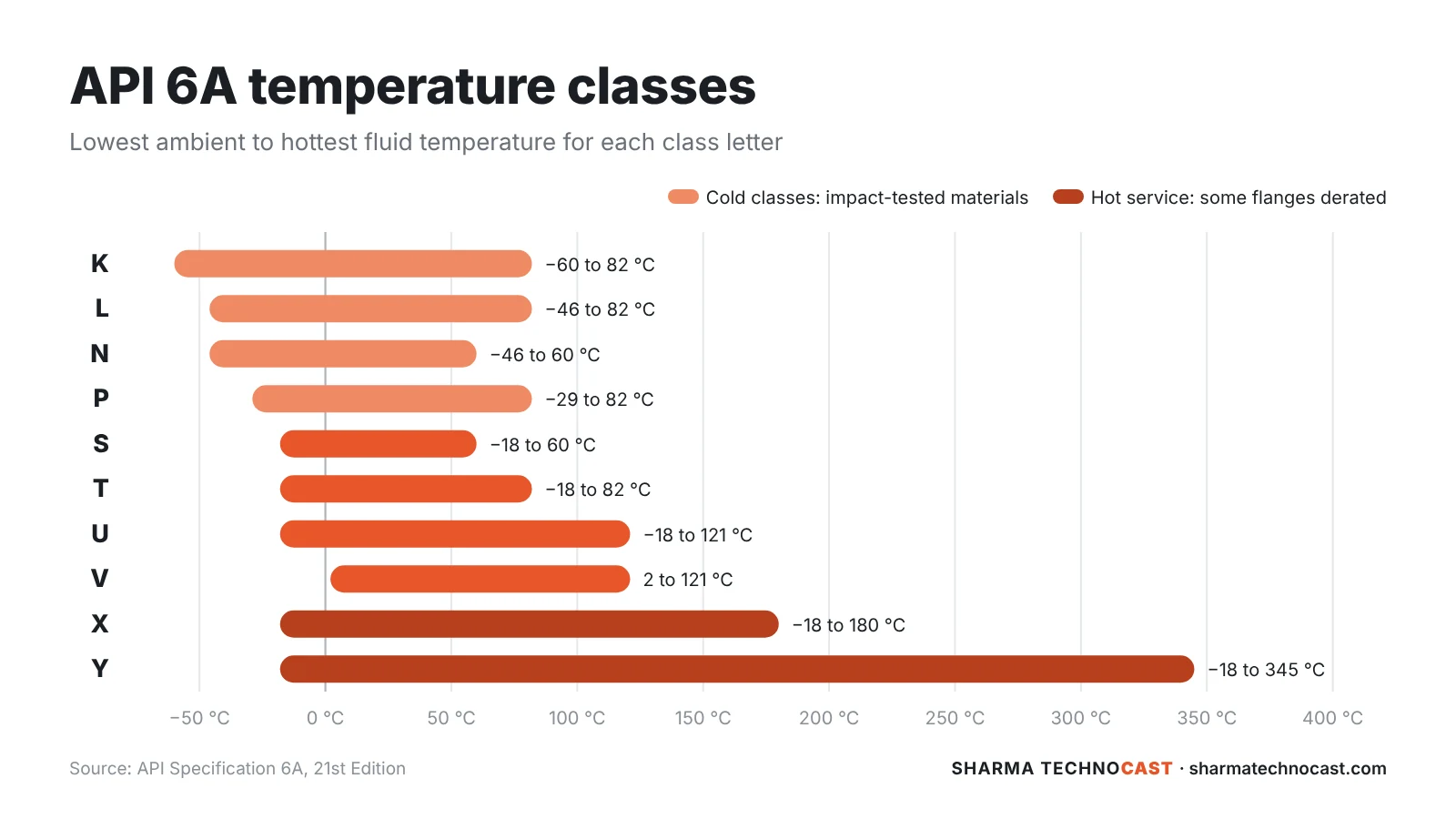
The temperature class is a letter. The minimum is the lowest ambient temperature the equipment may face. The maximum is the hottest fluid that may touch it.
| Class | Range (°C) | Range (°F) |
|---|---|---|
| K | −60 to 82 | −75 to 180 |
| L | −46 to 82 | −50 to 180 |
| N | −46 to 60 | −50 to 140 |
| P | −29 to 82 | −20 to 180 |
| S | −18 to 60 | 0 to 140 |
| T | −18 to 82 | 0 to 180 |
| U | −18 to 121 | 0 to 250 |
| V | 2 to 121 | 35 to 250 |
| X | −18 to 180 | 0 to 350 |
| Y | −18 to 345 | 0 to 650 |
Classes can be combined. P+U (−29 to 121 °C) is a common rating for gate valves. Classes X and Y are for hot service such as steam injection, and at those temperatures the allowable pressure of some flanges is reduced, so the full rating no longer applies. For cold sites, the low end of the range matters as much as the top: the classes for colder ambients (K, L, N and P) call for impact-tested materials.
Material Classes: General vs Sour Service
| Class | Service | Body, bonnet and end connections | Pressure-controlling parts (stems, seats, hangers) |
|---|---|---|---|
| AA | General | Carbon or low-alloy steel | Carbon or low-alloy steel |
| BB | General | Carbon or low-alloy steel | Stainless steel |
| CC | General | Stainless steel | Stainless steel |
| DD | Sour | Carbon or low-alloy steel | Carbon or low-alloy steel |
| EE | Sour | Carbon or low-alloy steel | Stainless steel |
| FF | Sour | Stainless steel | Stainless steel |
| HH | Sour | Corrosion-resistant alloy (CRA) | CRA |
The table shows the minimum material for each class. A higher-grade material, up to CRA, is always allowed. “Sour” means the well fluid contains hydrogen sulphide (H₂S), and classes DD to HH must meet NACE MR0175 / ISO 15156. Sour-service equipment is also marked with its H₂S limit, or NL where no limit applies. A further class, ZZ, covers sour service outside the limits of that standard. If the well might ever produce H₂S, say so in the enquiry: a part made for class AA cannot be converted to sour service later.
PSL: How Much Checking Goes Into Each Part
The product specification level (PSL 1 to 4) sets how much testing, inspection and documentation each part gets. Each step up adds work: PSL 2 adds surface NDE on wetted and sealing surfaces and a hardness test; PSL 3 adds full surface NDE, more hardness tests, impact tests for every temperature class and a serial number on each part; PSL 4 adds still tighter rules. Since the 21st edition, API 6A sets a minimum PSL by pressure rating and material class:
| Material class | 2,000 to 5,000 psi | 10,000 psi | 15,000 psi | 20,000 psi |
|---|---|---|---|---|
| AA, BB, CC | PSL 1 | PSL 2 | PSL 2 | PSL 3 |
| DD, EE, FF | PSL 1 | PSL 2 | PSL 3 | PSL 3 |
| HH | PSL 3 | PSL 3 | PSL 3 | PSL 4 |
These are minimums. Many operators specify PSL 3 for all critical wellhead and frac equipment, whatever the pressure.
PR1 and PR2: Design Validation
The performance requirement says how hard the design was tested before production started. PR1 is the basic level. PR2 is a more demanding validation, and equipment validated to the procedures in Annex F of API 6A is marked PR2F. Surface and underwater safety valves must be PR2. For other equipment, the end user chooses.
Flanges and Ring Gaskets by Pressure Rating
| Flange type | Where it is used | Ring gasket |
|---|---|---|
| 6B | 2,000, 3,000 and 5,000 psi, smaller sizes | R or RX |
| 6BX | All sizes at 10,000, 15,000 and 20,000 psi, plus the larger sizes at 2,000 to 5,000 psi | BX |
An RX gasket fits the same groove as an R gasket and seals better as pressure rises. BX gaskets fit 6BX grooves only. An API 6A flange is not interchangeable with an ASME B16.5 flange of a similar pressure class just because the numbers look close: ratings, materials, bolting and gaskets differ, so any mixed connection needs an engineering check.
How to Write an API 6A Enquiry
- Equipment and size: for example, a 2-1/16 in gate valve or a 7-1/16 in adapter spool, with a drawing if it is not a standard item.
- Rated working pressure: one of the six ratings, for each end if they differ.
- Temperature class: from the lowest site ambient to the hottest fluid, for example P+U.
- Material class: AA to HH, and the H₂S partial pressure if the service is sour.
- PSL and PR: at least the minimum in the table above, or your company standard.
- End connections and gaskets: 6B or 6BX flanges, studded ends or unions, and R, RX or BX ring gaskets.
- Documents: material test reports, test charts, NDE reports, and whether the API Monogram is required. If it is, ask for the supplier’s licence number and check it on the API Composite List.
- Quantity and delivery date: so the supplier can plan forgings and heat treatment.
API 6A Components from Sharma Technocast
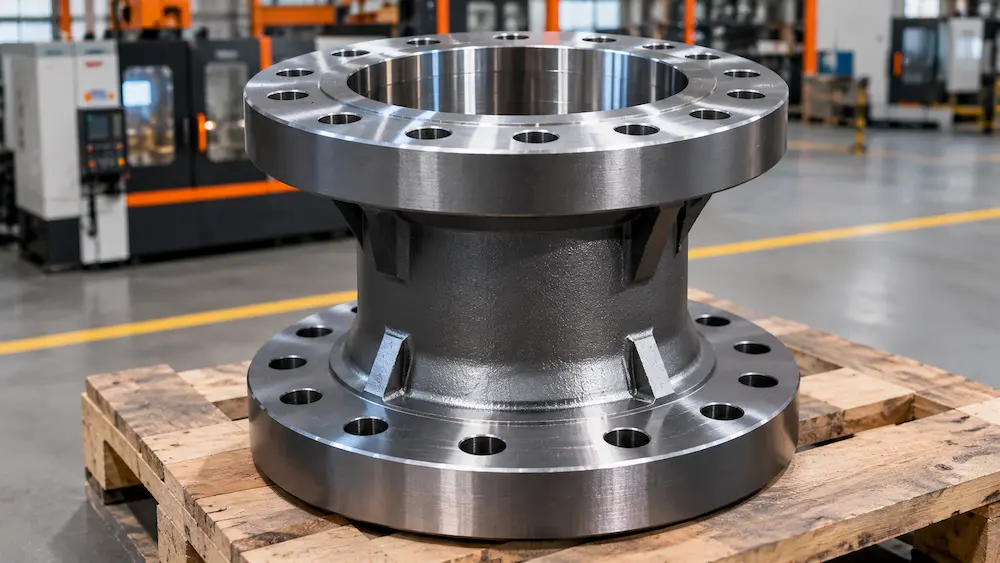
We manufacture oilfield pressure-control parts in Ahmedabad, starting from forgings made at our forging facility and finished on our CNC machine lines. The range includes adapter spools, blind and test flanges, flanged and studded crosses and tees, casing heads, tubing heads and casing spools, frac valves and API 6A ring gaskets in R, RX and BX profiles.
Send us the rating line for your part (size, pressure, temperature class, material class, PSL and PR) with the drawing and quantity, and we will quote within 24–48 hours. See all our oilfield parts.
Request an oilfield parts quote →
FAQs: API 6A Pressure Ratings
What are the API 6A pressure ratings?
API 6A has six rated working pressures: 2,000, 3,000, 5,000, 10,000, 15,000 and 20,000 psi, equal to 13.8, 20.7, 34.5, 69.0, 103.5 and 138.0 MPa. There are no in-between ratings, so equipment is chosen at the next rating above the maximum expected pressure.
What is the test pressure for 10,000 psi API 6A equipment?
The hydrostatic body test pressure for 10,000 psi equipment is 15,000 psi, or 1.5 times the rated working pressure. 15,000 psi equipment is tested at 22,500 psi and 20,000 psi equipment at 30,000 psi.
What does PSL mean in API 6A?
PSL stands for product specification level. PSL 1 to 4 set how much testing, inspection and documentation each part receives, from basic checks at PSL 1 to full surface NDE, more hardness and impact testing and serial numbers at PSL 3 and above. API 6A sets a minimum PSL by pressure rating and material class.
Which API 6A material class is used for sour service?
Material classes DD, EE, FF and HH are for sour service, where the well fluid contains hydrogen sulphide. They must meet NACE MR0175 / ISO 15156. AA, BB and CC are for general service.
What does temperature class P+U mean?
P+U combines class P (down to −29 °C) with class U (up to 121 °C), so the equipment is rated from −29 °C to 121 °C (−20 °F to 250 °F). It is a common rating for API 6A gate valves.
Which ring gasket fits a 10,000 psi API 6A flange?
10,000 psi flanges are 6BX flanges and take BX ring gaskets. R and RX gaskets are used with 6B flanges at 2,000, 3,000 and 5,000 psi.