

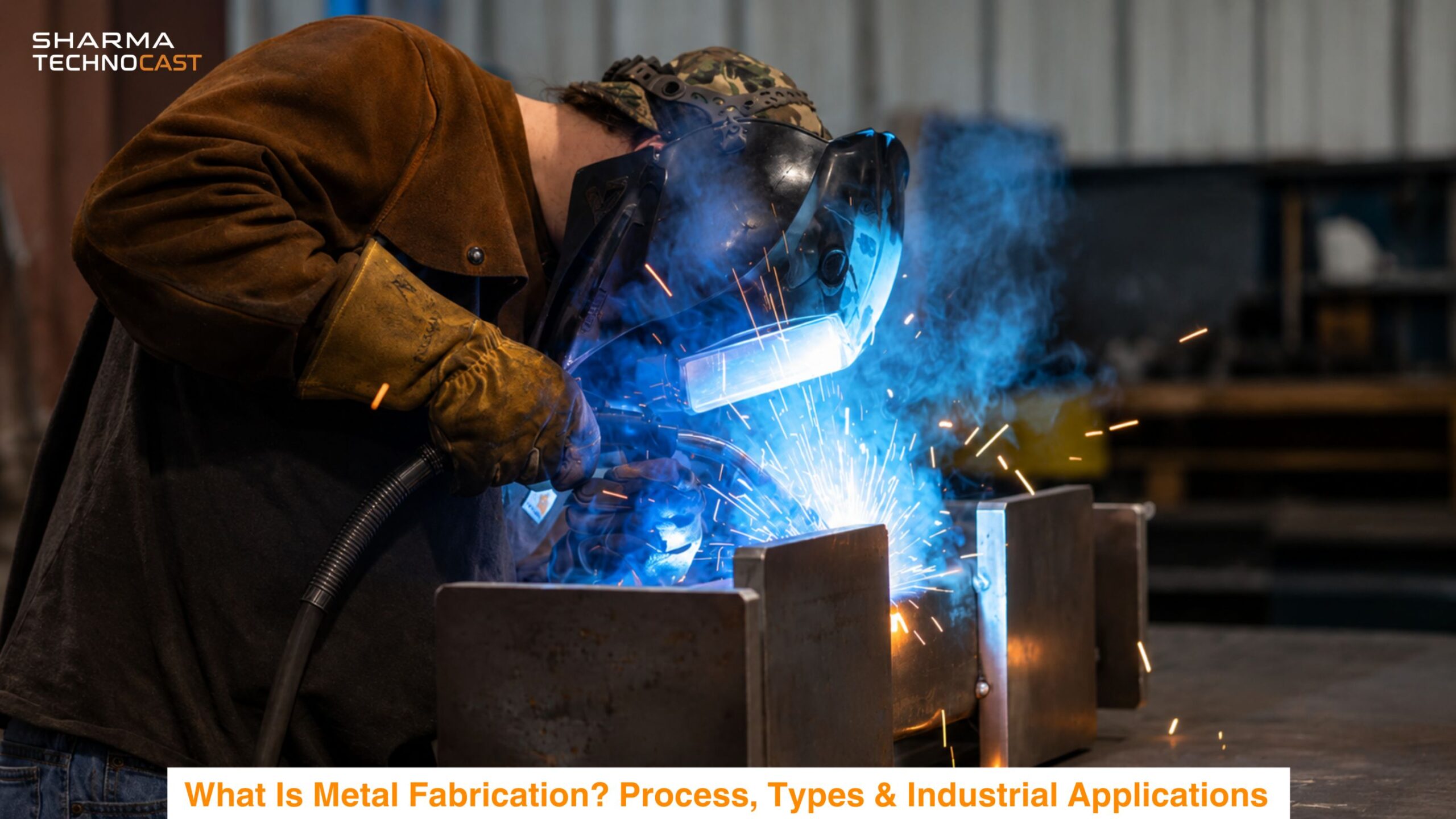
What Is Metal Fabrication? Process, Types & Industrial Applications
Metal fabrication is one of the most widely used manufacturing processes in modern industry. From the structural beams inside a commercial building to the equipment skids on an offshore platform, fabricated metal components are everywhere — yet most industrial buyers and engineers encounter the term without fully understanding what the process involves, how it differs from casting or machining, and what determines the quality of a fabricated component.
For OEMs, EPC contractors, plant maintenance teams, and industrial procurement buyers, understanding metal fabrication matters because it directly affects how components are specified, sourced, and quality-checked. In this guide, we explain what metal fabrication is, how the process works from raw material to finished assembly, the different types of fabrication, what tools and welding methods are used, and which industries depend on it most.
What Is Metal Fabrication?
Metal fabrication is the process of transforming raw metal stock — plates, sheets, bars, tubes, and structural sections — into finished components, structures, or assemblies through a series of manufacturing operations including cutting, forming, welding, and finishing. Unlike casting, which shapes metal by pouring it molten into a mold, or machining, which removes material from a solid block, fabrication builds components by cutting metal to shape and joining the pieces together.
The term covers a broad range of work — from a single welded bracket to an entire process plant structure. A fabricated component can be as simple as a bent and welded steel frame or as complex as a multi-tonne pressure vessel assembled from rolled plates, forged flanges, machined nozzles, and welded internals.
Metal fabrication is a value-added manufacturing process, meaning it takes lower-cost raw material and transforms it into a higher-value finished product through skilled labor, engineering, and equipment.
Is Metal Fabrication the Same as Welding?
No. Metal fabrication and welding are not the same thing, though they are closely related. Welding is one step within the broader fabrication process.
Metal fabrication is the complete process of transforming raw metal into a finished component — including design, cutting, forming, welding, finishing, and inspection. Welding is specifically the joining step where two or more metal pieces are fused together using heat, pressure, or both.
Every fabrication project involves welding, but welding alone is not fabrication. A welder joins pieces together. A fabricator designs, cuts, forms, welds, finishes, and inspects the entire component from raw material to final dispatch. Think of welding as one tool in the fabricator’s toolkit — essential, but not the whole process.
Types of Metal Fabrication
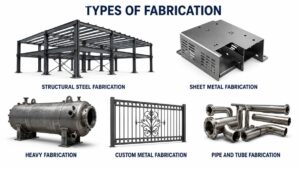
Metal fabrication covers several distinct categories depending on the size, complexity, material thickness, and application of the work.
Structural Steel Fabrication
Fabrication of beams, columns, trusses, platforms, staircases, handrails, pipe racks, and building frames for construction, industrial plants, and infrastructure projects. Structural fabrication typically involves heavy carbon steel sections and follows codes like IS 800, AISC, or EN 1090. This is the most visible form of fabrication — every industrial facility, commercial building, and bridge involves structural steel fabrication.
Sheet Metal Fabrication
Fabrication of enclosures, panels, brackets, ducts, housings, chassis, and covers from thin sheet metal — typically under 6mm thickness. Sheet metal fabrication is common in electrical enclosures, HVAC systems, automotive components, consumer products, and electronic equipment housings. The work involves precision cutting, bending on press brakes, and spot welding or TIG welding for clean joints.
Heavy Fabrication
Fabrication of large, thick, high-load components such as pressure vessels, storage tanks, heat exchangers, boiler components, offshore structures, and heavy equipment frames. Heavy fabrication involves thick plate rolling, multi-pass welding, post-weld heat treatment, and rigorous NDT inspection. Components can weigh from several hundred kilograms to hundreds of tonnes.
Custom Metal Fabrication
One-off or small-batch fabrication of components built to specific customer drawings and specifications. Custom metal fabrication serves OEM manufacturers, prototype development, and specialized industrial applications where standard catalogue products are not available. Every dimension, material, and finish is dictated by the buyer’s drawing.
Pipe and Tube Fabrication
Fabrication of piping spools, pipe supports, pipe racks, and tubular structures for process plants, refineries, power stations, and water treatment facilities. Pipe fabrication involves cutting, beveling, fit-up, welding, and testing of piping assemblies that carry fluids, gases, and steam within industrial systems.
How Does the Metal Fabrication Process Work?
The metal fabrication process follows a series of stages from engineering design through to final inspection. While every project differs in complexity, the core stages are consistent across most fabrication work.
Stage 1 — Design and Engineering
Every fabricated component starts with an engineering drawing or 3D CAD model. The design defines the geometry, dimensions, material grade, weld specifications, tolerances, and surface finish requirements. For structural and pressure-containing fabrications, the design also specifies the applicable codes and standards that govern how the component must be built and tested.
Design review between the fabricator and the buyer ensures the component can be manufactured efficiently without compromising the engineering requirements. This stage is where material selection, joint design, and inspection criteria are finalized before any metal is cut.
Stage 2 — Material Selection and Preparation
Raw metal stock is selected based on the design specification — carbon steel plates for structural work, stainless steel sheets for corrosion-resistant applications, aluminum for lightweight assemblies. The material is verified against mill test certificates to confirm grade, composition, and mechanical properties before fabrication begins.
Material preparation includes straightening, cleaning, surface preparation, and nesting — the process of arranging cut patterns on the raw plate to minimize waste and maximize material utilization.
Stage 3 — Cutting
The raw metal is cut to the required shapes and sizes. Modern fabrication facilities use several cutting methods depending on the material, thickness, and precision required:
- Laser cutting — high precision, clean edges, ideal for thin to medium sheet metal and complex profiles
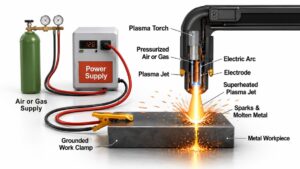
- Plasma cutting — fast, cost-effective cutting for thicker carbon steel plates up to 50mm and beyond
- Waterjet cutting — cuts virtually any material without heat-affected zones, ideal for heat-sensitive metals and composites
- Oxy-fuel cutting — traditional thermal cutting for heavy carbon steel plate, commonly used in structural and heavy fabrication
- Shearing — mechanical cutting for straight-line cuts on sheet metal
The choice of cutting method affects edge quality, dimensional accuracy, heat input, and downstream welding requirements.
Stage 4 — Forming and Bending
After cutting, flat metal pieces are formed into three-dimensional shapes using mechanical force:
- Press brake bending — folding sheet and plate metal along straight lines to create angles, channels, and box sections
- Roll bending — curving plates and sections into cylindrical or conical shapes for vessels, tanks, and ducts
- Stamping and punching — creating holes, slots, and shaped features in sheet metal
- Roll forming — continuous bending of long metal strips into uniform cross-section profiles
Forming is done cold for thinner materials and hot for thick plates and heavy sections that would crack or spring back if bent cold.
Stage 5 — Welding and Assembly
The cut and formed pieces are assembled and joined — most commonly by welding. The welding method depends on the material, thickness, joint design, and quality requirements. Beyond welding, assembly can also involve bolting, riveting, and mechanical fastening for components that need to be disassembled in service.
Welding quality is controlled through qualified welding procedures (WPS), certified welders, and inspection — including visual, NDT, radiographic, ultrasonic, and dye penetrant testing as required by the project code.
Stage 6 — Surface Treatment and Finishing
After assembly, the fabricated component undergoes finishing operations:
- Grinding and deburring — removing weld spatter, sharp edges, and surface imperfections
- Shot blasting or sand blasting — cleaning and preparing the surface for coating
- Painting or powder coating — protective surface coating for corrosion resistance
- Hot-dip galvanizing — zinc coating for long-term outdoor and marine corrosion protection
- Pickling and passivation — chemical treatment for stainless steel to restore corrosion resistance after welding
Stage 7 — Quality Control and Inspection
The finished fabrication is dimensionally inspected and tested before dispatch:
- Dimensional inspection against the engineering drawing
- Weld inspection — visual, UT, RT, MT, PT as specified
- Material verification — PMI testing to confirm correct material grade
- Hydrostatic or pneumatic pressure testing for pressure-containing fabrications
- Documentation — mill test certificates, weld maps, NDT reports, dimensional reports, and coating certificates
At Sharma Technocast, our fabrication division operates under an ISO 9001 quality management system with full material traceability and documentation on every project.
What Are the 4 Types of Welding Used in Metal Fabrication?
The four most common welding types used in metal fabrication are MIG, TIG, Stick, and Flux-cored. A fifth method — Submerged Arc Welding — is also widely used in heavy fabrication.
MIG Welding (GMAW — Gas Metal Arc Welding)
A continuously fed wire electrode is melted into the weld joint under a shielding gas (typically argon or CO2 mix). MIG welding is the most widely used method in fabrication shops — it is fast, easy to learn, and works well on carbon steel, stainless steel, and aluminum. Best for medium-thickness materials and production welding.
TIG Welding (GTAW — Gas Tungsten Arc Welding)
A non-consumable tungsten electrode creates the arc while a separate filler rod is fed manually into the weld pool under argon shielding gas. TIG welding produces the cleanest, most precise welds and is preferred for stainless steel, alloy steel, aluminum, and thin-wall components where appearance and quality are critical.
Stick Welding (SMAW — Shielded Metal Arc Welding)
A consumable electrode coated in flux is melted into the weld joint. The flux coating creates a shielding gas and slag layer that protects the weld. Stick welding is robust, portable, and works outdoors in wind — making it the go-to method for structural and field fabrication.
Flux-Cored Arc Welding (FCAW)
Similar to MIG but uses a tubular wire filled with flux instead of solid wire. FCAW offers high deposition rates and works well in outdoor and windy conditions. It is widely used in structural steel fabrication, shipbuilding, and heavy construction.
Submerged Arc Welding (SAW)
The arc is submerged under a blanket of granular flux, producing deep-penetration welds with very high deposition rates. SAW is used for long, straight welds on thick plate — common in pressure vessel fabrication, tank fabrication, and pipe mill production.
What Is 1G, 2G, 3G, 4G, 5G, 6G Welding Positions?
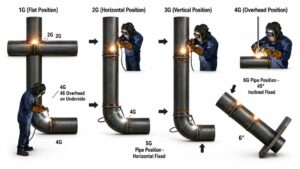
Welding position codes indicate the orientation of the weld joint during welding. The “G” stands for “groove” weld. Position matters because welding against gravity is significantly more difficult and requires higher welder skill and different technique.
- 1G — Flat position — The weld joint is horizontal and the welder works from above. The easiest position. Gravity helps the weld pool settle into the joint.
- 2G — Horizontal position — The weld axis is horizontal but the weld is on a vertical surface. The welder works from the side. Moderate difficulty.
- 3G — Vertical position — The weld axis is vertical. The welder works upward or downward against gravity. Requires good technique to prevent the weld pool from sagging.
- 4G — Overhead position — The weld joint is above the welder’s head. The most difficult flat/groove position. Gravity pulls the molten metal downward — demanding precise control of heat and travel speed.
- 5G — Pipe fixed horizontal — The pipe is horizontal and fixed (cannot be rotated). The welder must weld around the full circumference — transitioning from flat to vertical to overhead in a single weld pass. Used in pipeline fabrication.
- 6G — Pipe fixed at 45° angle — The pipe is fixed at a 45-degree incline. The welder must handle every position — flat, vertical, horizontal, and overhead — within a single weld joint. This is the most difficult welding position and is used as the qualification test for pipeline welders. A welder certified in 6G is considered qualified for all other positions.
Understanding welding positions is important for industrial buyers because the position affects weld quality, welder qualification requirements, and fabrication cost. Components that require 5G or 6G welding need higher-skilled welders and take longer to produce.
What Tools Are Used in Metal Fabrication?
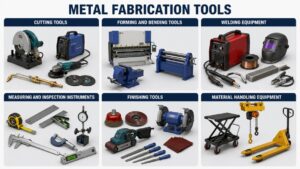
Metal fabrication requires a range of specialized tools and equipment across each stage of the process. The six main categories of tools used in fabrication are:
1. Cutting Tools
Laser cutting machines, plasma cutting tables, waterjet cutters, oxy-fuel torches, band saws, shearing machines, and angle grinders. These tools cut raw metal stock into the required shapes and sizes.
2. Forming and Bending Tools
Press brakes, plate rolling machines, section bending machines, hydraulic presses, stamping dies, and tube benders. These tools shape flat metal into three-dimensional forms without removing material.
3. Welding Equipment
MIG welding machines, TIG welding machines, stick welders, flux-cored welders, submerged arc welding systems, welding positioners, and welding rotators. The welding setup also includes shielding gas systems, filler wire feeders, and welding fixtures.
4. Measuring and Inspection Instruments
Vernier calipers, micrometers, tape measures, laser levels, coordinate measuring machines (CMM), ultrasonic thickness gauges, weld gauges, and surface roughness testers. Precision measurement is essential at every stage of fabrication.
5. Finishing Tools
Angle grinders, flap discs, belt sanders, shot blasting machines, sand blasting cabinets, paint spray equipment, and powder coating ovens. Finishing tools prepare the surface and apply protective coatings.
6. Material Handling Equipment
Overhead cranes, forklifts, chain hoists, pipe rollers, welding positioners, and lifting magnets. Heavy fabrication involves moving large, heavy components between workstations — safe material handling is critical for both productivity and safety.
Materials Used in Metal Fabrication
Metal fabricators work with a range of materials selected based on the project’s strength, weight, temperature, and corrosion requirements:
- Carbon steel — the most widely used fabrication material for structural, industrial, and general engineering applications
- Stainless steel — for corrosion-resistant applications in chemical processing, food, pharma, and marine environments
- Alloy steel — for high-temperature and high-pressure applications in power generation and petrochemical plants
- Aluminum — lightweight, corrosion-resistant fabrication for marine, aerospace, and transportation applications
- Copper and brass — for electrical, thermal, and decorative applications
- Galvanized steel — pre-coated carbon steel for outdoor and corrosion-prone environments
Industries That Rely on Metal Fabrication
Metal fabrication serves virtually every industrial sector:
- Construction — structural steel frames, platforms, staircases, handrails, cladding support structures
- Oil and gas — pressure vessels, storage tanks, pipe racks, equipment skids, offshore structures
- Power generation — boiler components, ducts, stacks, turbine housings, structural supports
- Petrochemical — reactors, columns, heat exchangers, process piping, modular plant units
- Water treatment — tanks, clarifiers, filter housings, pipe supports, structural platforms
- Automotive — chassis components, frames, brackets, exhaust systems, tooling fixtures
- Shipbuilding — hull sections, deck structures, pipe systems, accommodation modules
- Mining and heavy equipment — crusher frames, conveyor structures, hopper bodies, bucket assemblies
- Food and pharmaceutical — hygienic stainless steel enclosures, process vessels, clean room structures
Conclusion
Metal fabrication transforms raw metal into the structures and components that every industry depends on. From a simple welded bracket to a complex multi-tonne assembly, the quality of fabrication depends on engineering, material selection, skilled execution, and rigorous inspection at every stage.
If you need fabricated components for an industrial project and want to understand how fabrication fits your requirements, sharing your drawing or specification with an experienced fabrication company is the simplest starting point.
Frequently Asked Questions
What is metal fabrication?
Metal fabrication is the process of cutting, forming, welding, and finishing raw metal stock into finished components, structures, or assemblies for industrial use.
Is metal fabrication the same as welding?
No. Welding is one step within the broader fabrication process. Fabrication includes design, cutting, forming, welding, finishing, and inspection. Welding specifically refers to the joining of metal pieces using heat.
What are the main types of metal fabrication?
The main types are structural steel fabrication, sheet metal fabrication, heavy fabrication (pressure vessels, tanks), custom fabrication, and pipe and tube fabrication.
What is the difference between metal fabrication and metal casting?
Fabrication cuts and joins metal pieces together to build a component. Casting pours molten metal into a mold to create a shape. Fabrication is preferred for large structural assemblies; casting is preferred for complex shapes produced in volume.
What is the difference between metal fabrication and machining?
Fabrication builds components by cutting and welding pieces together. Machining removes material from a solid block to achieve a precise shape. Many industrial components require both — fabrication for the overall structure and machining for critical dimensions.
What are the 4 types of welding used in fabrication?
The four most common types are MIG (GMAW), TIG (GTAW), Stick (SMAW), and Flux-Cored Arc Welding (FCAW). Submerged Arc Welding (SAW) is also widely used in heavy fabrication.
What do 1G, 2G, 3G, 4G, 5G, and 6G welding positions mean?
These codes indicate the orientation of the weld joint. 1G is flat (easiest), 2G is horizontal, 3G is vertical, 4G is overhead, 5G is fixed horizontal pipe, and 6G is fixed pipe at 45 degrees (most difficult). A welder certified in 6G is qualified for all positions.
What tools are used in metal fabrication?
The six main categories are cutting tools (laser, plasma, waterjet), forming tools (press brakes, rolling machines), welding equipment (MIG, TIG, stick machines), measuring instruments (calipers, CMM, weld gauges), finishing tools (grinders, blasting, coating), and material handling equipment (cranes, forklifts, hoists).
What is custom metal fabrication?
Custom metal fabrication is the manufacturing of one-off or small-batch components built to specific customer drawings and specifications, as opposed to standard catalogue products.
What is sheet metal fabrication?
Sheet metal fabrication involves cutting, bending, and assembling thin metal sheets — typically under 6mm — into enclosures, panels, brackets, ducts, and housings for electrical, HVAC, automotive, and industrial applications.
