

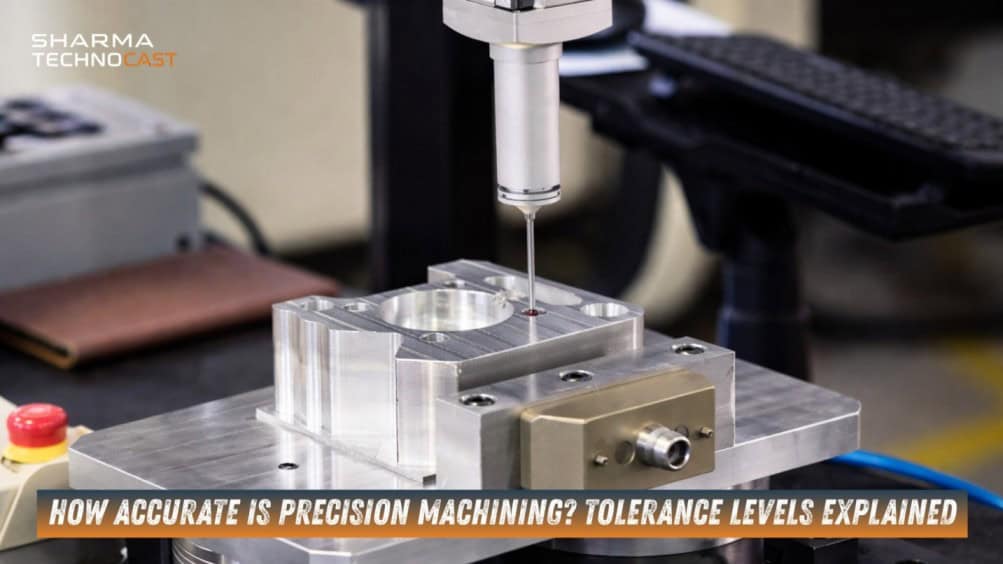
Precision machining is widely used in industries where accuracy, consistency, and tight tolerances are critical. From aerospace and automotive components to medical devices and industrial machinery, precision machining ensures parts fit perfectly and perform reliably.
But one common question engineers and buyers ask is
How accurate is precision machining, and what tolerance levels can be achieved?
In this blog, we explain precision machining accuracy, tolerance ranges, influencing factors, CNC machining tolerances, and why choosing the right precision machining manufacturer matters.
What Is Precision Machining Accuracy?
Precision machining accuracy refers to how closely a manufactured part matches its intended design dimensions. Accuracy is typically measured in microns (µm) or millimeters (mm) and defines the allowable deviation from the specified dimension.
In simple terms:
Higher accuracy = tighter tolerances
Lower accuracy = wider tolerances
Precision machining is designed to achieve repeatable, consistent accuracy across multiple components.
Many industrial components start as metal castings or forged components and are later finished through precision machining to achieve the required accuracy, surface finish, and fitment.
What Are Tolerances in Precision Machining?
A tolerance is the allowable variation in a physical dimension of a part. No manufacturing process can produce parts with zero deviation, so tolerances define acceptable limits.
Example:
If a shaft diameter is specified as 50.00 mm ±0.01 mm
The acceptable size range is 49.99 mm to 50.01 mm
Typical Precision Machining Tolerance Levels
Standard CNC Machining Tolerances
Most CNC machining operations achieve tolerances of:
±0.05 mm to ±0.01 mm
This level is suitable for:
Industrial machinery parts
Automotive components
Fabrication and engineering assemblies
High-Precision CNC Machining Tolerances
Advanced precision machining processes can achieve:
±0.005 mm to ±0.002 mm
Used in:
Aerospace components
Medical equipment
High-performance industrial applications
Ultra-Precision Machining
In specialized cases, ultra-precision machining can reach:
±0.001 mm or tighter
This is typically required for:
Optical components
Advanced aerospace systems
Precision instruments
Factors That Affect Precision Machining Accuracy
1. CNC Machine Capability
Modern CNC machines with rigid structures and advanced controls deliver higher accuracy and repeatability.
2. Tooling Quality
High-quality cutting tools reduce vibration, tool wear, and dimensional variation.
3. Material Properties
Different materials behave differently during machining:
Hard materials require controlled cutting
Softer materials may deform under cutting forces
4. Temperature Control
Heat generated during machining can cause thermal expansion, affecting tolerances. Precision shops control temperature carefully.
5. Manufacturing Process Flow
In many cases, parts undergo fabrication processes such as cutting, forming, or welding before final machining. Proper process planning ensures these steps do not affect final accuracy.
Precision Machining vs Conventional Machining Accuracy
| Feature | Precision Machining | Conventional Machining |
|---|---|---|
| Typical Tolerance | ±0.01 mm or better | ±0.1 mm |
| Repeatability | Very high | Moderate |
| Surface Finish | Excellent | Average |
| Complex Geometry | Easily achievable | Limited |
Precision machining clearly offers superior dimensional control and consistency.
Industries That Require High-Precision Machining Accuracy
Precision machining accuracy is critical in industries such as:
Automotive manufacturing
Aerospace & defense
Oil & gas
Medical devices
Power generation
Heavy engineering
Industrial automation
How Precision Machining Ensures Consistent Accuracy
Precision machining achieves consistency through:
CNC-controlled movements
Automated toolpaths
In-process inspection
Quality control using CMM and gauges
Repeatable machining programs
This ensures every component meets the same tolerance requirements, even in large production volumes.
Precision Machining Manufacturer in India
Choosing a reliable precision machining manufacturer in India is essential for achieving tight tolerances and consistent quality.
A professional manufacturer offers:
Advanced CNC machines
Skilled machinists and engineers
Strict quality inspection systems
Experience with tight-tolerance components
Why Choose Sharma Technocast for Precision Machining?
Sharma Technocast is a trusted precision machining services manufacturer in India, delivering high-accuracy CNC machined components for industrial and engineering applications.
Our Precision Machining Capabilities
CNC turning & CNC milling
Tight-tolerance machining
Custom precision-machined components
Consistent repeatability
Strict quality inspection
Common Tolerance Questions in Precision Machining
What tolerance is considered precision machining?
Typically ±0.01 mm or tighter is considered precision machining.
Can CNC machining achieve micron-level accuracy?
Yes, advanced CNC machines can achieve micron-level tolerances for high-precision applications.
Is precision machining expensive?
While precision machining may cost more than conventional machining, it reduces rework, failures, and long-term costs.
Which materials are best for precision machining?
Steel, stainless steel, aluminum, brass, and engineering alloys are commonly used.
Precision machining offers exceptional accuracy, tight tolerance control, and repeatability, making it essential for modern industrial manufacturing. Understanding tolerance levels and influencing factors helps engineers and buyers select the right machining partner.
If you are looking for a reliable precision machining manufacturer in Ahmedabad, India, Sharma Technocast delivers precision-engineered components that meet demanding industrial standards.
FAQs – Precision Machining Accuracy
How accurate is precision machining?
Precision machining can achieve tolerances as tight as ±0.005 mm or better, depending on application and machine capability.
What affects CNC machining accuracy?
Machine quality, tooling, material properties, programming, and temperature control affect accuracy.
Which industries need tight machining tolerances?
Aerospace, automotive, medical, oil & gas, and heavy engineering industries require tight tolerances.
Who provides precision machining services in India?
Sharma Technocast provides high-accuracy precision machining services in India for industrial applications.
